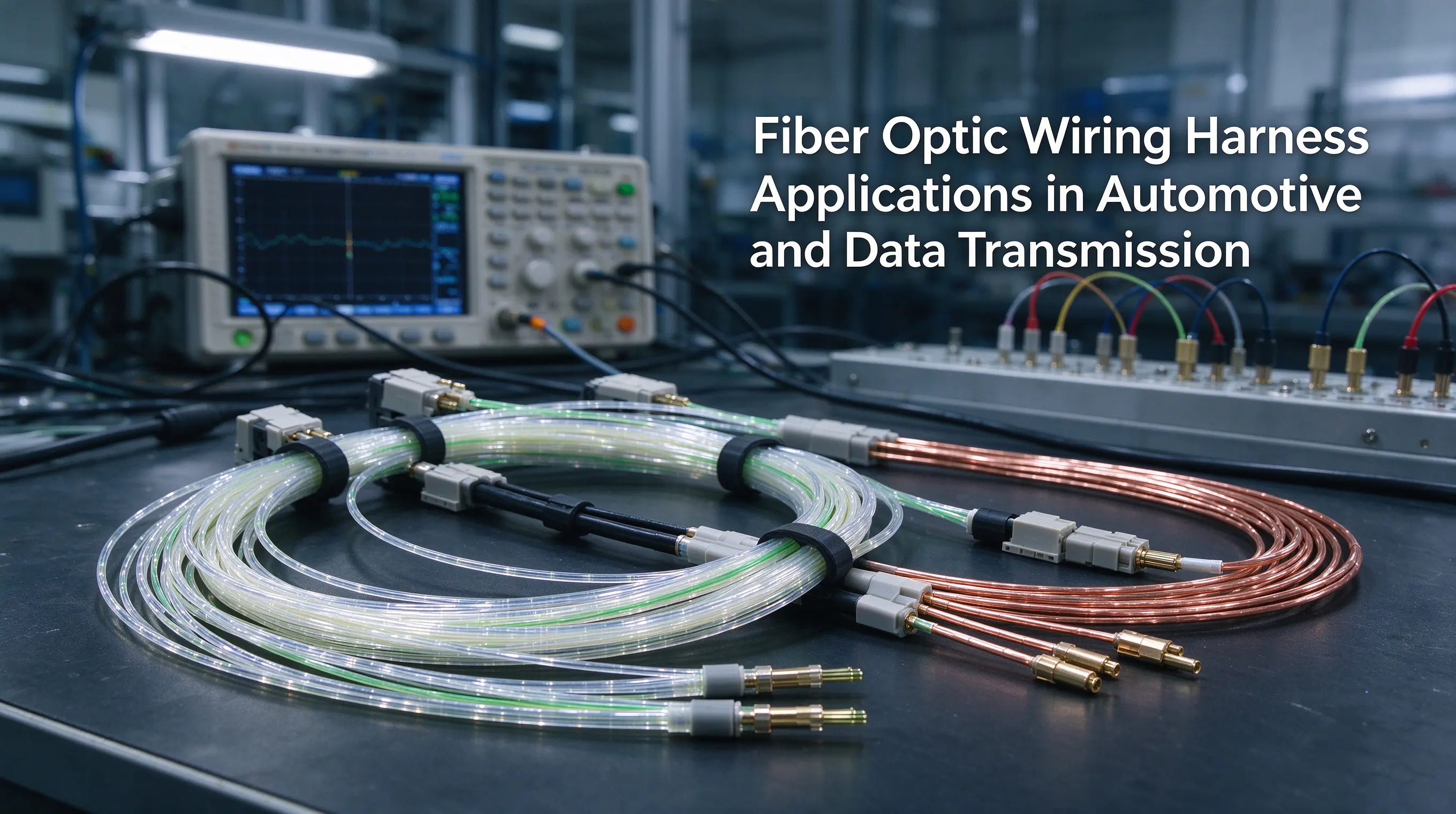
Driven by the rapid advancement of intelligent vehicle technologies and high-speed digital communication systems, conventional copper-based wiring harnesses can no longer satisfy the escalating requirements of modern transmission systems, including ultra-high bandwidth, ultra-low latency, superior anti-electromagnetic interference performance and lightweight integration. As a pivotal high-performance transmission medium, fiber optic wiring harnesses exhibit prominent strengths in signal transmission efficiency, environmental adaptability and operational stability. This paper comprehensively elaborates on the structural features and unique performance advantages of automotive-grade fiber optic wiring harnesses. It focuses on their representative application scenarios in intelligent vehicle systems and modern high-speed data transmission infrastructure, systematically discusses prevailing industrial technical standards, key application bottlenecks and future technological evolution trends, and provides valuable references for the large-scale popularization and innovative iterative application of fiber optic wiring harness technology in relevant industrial fields.
1. Introduction
The global digital transformation of the automotive industry and the explosive surge of cross-border data traffic have imposed stringent new criteria on wired signal transmission media. In the automotive sector, the widespread deployment of autonomous driving systems, intelligent cockpit platforms and vehicle networking (V2X) technologies has generated an enormous volume of real-time sensing, control and multimedia data, placing higher demands on transmission speed and stability. In the field of data communication, the rapid development of cloud computing, edge computing and 5G/6G next-generation communication systems urgently requires transmission media with high bandwidth capacity, low signal attenuation and strong anti-interference capability to support large-scale, high-efficiency data interaction.
Traditional copper wiring harnesses are plagued by inherent technical limitations, including significant signal attenuation under high-frequency operation, weak resistance to electromagnetic interference, excessive weight and constrained bandwidth, which severely hinder the performance upgrading and system integration of modern automotive and data transmission systems. In contrast, fiber optic wiring harnesses that transmit signals via optical waves fundamentally overcome the technical defects of conductive copper cables. They have emerged as the preferred alternative transmission medium for high-end intelligent vehicles and large-scale data transmission systems. This paper systematically summarizes the core application value and technical superiority of fiber optic wiring harnesses in automotive engineering and high-speed data transmission, and further explores their future development pathways and industrial application potential.
2. Overview and Core Advantages of Fiber Optic Wiring Harnesses
2.1 Basic Structure and Automotive-Grade Characteristics
A complete fiber optic wiring harness consists of optical fiber cores, high-strength reinforcement layers, insulating buffer sleeves and dedicated precision connectors, integrating the dual functions of high-speed signal transmission and system circuit protection. Unlike civilian-grade ordinary optical fibers designed for stable indoor environments, automotive-grade fiber optic wiring harnesses are specially optimized for harsh vehicle operating conditions. Adopting aramid yarn reinforcement structures and halogen-free flame-retardant polymer buffer layers, these professional harnesses possess excellent comprehensive performance including mechanical vibration resistance, waterproof and dustproof capability, and wide-range high and low temperature resistance. They can stably adapt to complex and variable vehicle working conditions such as continuous jitter, humid environment and drastic temperature fluctuations inside and outside automotive bodies.
2.2 Core Performance Advantages Compared with Copper Harnesses
-
Superior high bandwidth and ultra-low latency: Fiber optic wiring harnesses support a single-channel transmission rate of up to 100 Gbit/s, which fully meets the real-time transmission demands of 4K/8K ultra-high-definition video streams and massive multi-sensor data. With a transmission delay controlled below 0.1 milliseconds, they can satisfy the ultra-high real-time operation requirements of core intelligent vehicle scenarios such as autonomous driving decision-making and dynamic road condition perception.
-
Excellent anti-electromagnetic interference capability: Different from conductive copper cables susceptible to electromagnetic coupling interference, optical signal transmission relies on light wave propagation without current conduction. This fundamental characteristic enables fiber optic harnesses to completely avoid signal distortion, data delay and information loss caused by external electromagnetic fields and vehicle high-voltage electrical systems, greatly improving the overall stability and reliability of signal transmission systems.
-
Remarkable lightweight and miniaturization advantages: Under the same data transmission capacity specification, the weight of fiber optic wiring harnesses is only one-fifth of that of traditional copper harnesses, and their wire diameter and occupied space are significantly reduced. The lightweight design effectively reduces the overall body weight of new energy and intelligent vehicles, thereby lowering driving energy consumption and effectively improving vehicle cruising range and energy utilization efficiency.
-
High operational safety and long-term durability: Fiber optic transmission media produce no electric leakage, electric spark or short-circuit risks, possessing excellent flame retardancy, corrosion resistance and aging resistance. They can adapt to complex installation positions and harsh working environments inside and outside vehicles, with outstanding environmental adaptability and long service life, reducing the frequency of equipment maintenance and replacement.
3. Applications of Fiber Optic Wiring Harnesses in Automotive Field
3.1 Intelligent Cockpit Multimedia Transmission
The intelligent cockpit multimedia system represents one of the earliest commercial and most mature application scenarios of automotive fiber optic wiring harnesses. Serving as the core high-speed transmission backbone of vehicle-mounted multimedia systems, fiber optic harnesses connect multiple cockpit terminal devices including the central control host, full LCD instrument panel, co-pilot entertainment screen, rear-row multimedia terminal and high-fidelity vehicle audio system. They support synchronous transmission of ultra-high-definition video streaming, multi-channel surround sound audio and real-time vehicle networking data, realizing barrier-free data interaction and synchronous linkage of multi-terminal cockpit equipment. According to industrial market data, vehicle infotainment and telematics scenarios account for 45.47% of the global automotive optical fiber market share, ranking as the largest and most mature application segment in the automotive optical fiber industry.
3.2 ADAS and Autonomous Driving Sensing Transmission
High-level autonomous driving systems rely on the collaborative perception and data fusion of multiple vehicle-mounted sensors, including lidar, panoramic surveillance cameras and millimeter-wave radars, which generate massive real-time environmental sensing data every second. Fiber optic wiring harnesses construct a high-bandwidth, low-latency and high-reliability dedicated transmission network for Advanced Driver Assistance Systems (ADAS). They ensure rapid and accurate transmission of massive perception data to the vehicle-mounted central computing platform, supporting real-time dynamic decision-making and executive control for core functions such as adaptive cruise control, intelligent lane keeping and automatic obstacle avoidance. The ultra-low transmission delay and strong anti-interference performance of fiber optic harnesses effectively eliminate potential driving safety hazards caused by signal distortion and data lag in complex driving scenarios.
3.3 Vehicle Zonal Network and Battery Management System
With the comprehensive upgrading of automotive electronic and electrical architecture towards modularization and zonal integration, fiber optic wiring harnesses have become the core connection backbone of vehicle zonal network systems. They realize efficient and stable data interconnection and collaborative control among vehicle central control units, body electronic systems, power drive systems and intelligent sensing modules. In new energy vehicles, fiber optic harnesses are also widely applied to high-precision data transmission of Battery Management Systems (BMS). They monitor core battery parameters including real-time voltage, operating temperature and state of charge (SOC) with high accuracy, providing reliable data support for battery safety protection, energy management and fault diagnosis, and ensuring the safe and stable operation of new energy power battery systems.
3.4 Automotive Ambient Lighting and Auxiliary Systems
Benefiting from their flexible bending performance and uniform soft light transmission characteristics, fiber optic wiring harnesses are widely used in automotive ambient lighting and auxiliary lighting systems. In high-end intelligent vehicles, they support the customized design of multi-color and multi-scene interior ambient lighting, enhancing the interior comfort and technological aesthetics of vehicles. Meanwhile, fiber optic harnesses are applied to external vehicle auxiliary lighting components such as vehicle indicator lights and tail lights, improving the recognition and warning effect of vehicle lighting systems and effectively boosting driving safety in low-light and night environments.
4. Applications of Fiber Optic Wiring Harnesses in Data Transmission Field
4.1 Data Center Internal Interconnection
In large-scale cloud data centers and server clusters, fiber optic wiring harnesses are essential connection media for high-speed interconnection between core equipment such as servers, network switches and storage arrays. They effectively break the bandwidth bottleneck and transmission rate limitation of traditional copper cable interconnection, and support ultra-large-scale batch data transmission and real-time data scheduling in data centers. In addition, the lightweight and compact structural design of fiber optic harnesses reduces wiring space occupation and system heat generation, optimizes the internal wiring layout of high-density data centers, and significantly improves the overall operational efficiency, heat dissipation performance and stability of data center systems.
4.2 5G/6G Communication Fronthaul and Backhaul
In modern mobile communication infrastructure, fiber optic wiring harnesses serve as the core transmission carrier for 5G and upcoming 6G communication fronthaul and backhaul links. They undertake high-efficiency data transmission tasks between remote radio units (RRU) and baseband processing units (BBU), stably supporting high-bandwidth, low-latency and large-connection communication service requirements. The excellent transmission performance of fiber optic harnesses lays a solid hardware foundation for the large-scale popularization of edge computing, industrial Internet connectivity, ultra-high-definition live broadcasting and other emerging digital services, and guarantees the high-quality operation of next-generation mobile communication networks.
4.3 Industrial and Intelligent Terminal Data Transmission
In intelligent manufacturing, industrial Internet and other industrial intelligent scenarios, production equipment usually faces complex interference environments such as strong electromagnetic radiation, high temperature and dust. Fiber optic wiring harnesses, with outstanding anti-interference and environmental adaptability, are widely used for signal and data transmission of industrial sensors, intelligent processing equipment and industrial control systems. They ensure the stable and uninterrupted transmission of industrial control instructions and production monitoring data, avoid production abnormalities caused by signal interference or data loss, and provide reliable technical guarantees for the safe, stable and efficient operation of industrial intelligent production systems.
5. Industry Technical Standards and Market Development Status
5.1 Core Industry Standards
The global fiber optic wiring harness industry has formed a complete and standardized technical specification system covering product design, production processing and performance testing. Among them, the newly updated ISO 24581:2024 international standard systematically standardizes the performance parameters, structural specifications and environmental durability test methods of high-speed vehicle-mounted optical fiber harnesses with a single-channel rate up to 100 Gbit/s. It comprehensively covers the technical requirements for in-vehicle line connection, equipment matching and system compatibility, providing a unified authoritative technical basis for standardized production and large-scale industrial application of automotive-grade fiber optic wiring harnesses worldwide.
5.2 Market Scale and Growth Trend
Driven by the iterative upgrading of global intelligent vehicle industry and the continuous construction of digital communication infrastructure, the market scale of fiber optic wiring harnesses maintains a steady and rapid growth trend. The automotive optical fiber market presents obvious segmented development characteristics: safety system application scenarios account for 29.82% of the market share, communication device transmission scenarios account for 19.99%, and vehicle lighting system scenarios account for 4.95%. In particular, the automotive high-speed optical cable market maintains a compound annual growth rate (CAGR) of 15.2%, far exceeding the average growth level of the traditional automotive wiring industry, making it the fastest-growing and most promising subdivision field in the automotive wiring harness industry.
6. Existing Challenges and Optimization Directions
6.1 Current Application Bottlenecks
-
High manufacturing and maintenance costs: Automotive-grade fiber optic wiring harnesses require precision manufacturing processes and high-performance special materials, resulting in higher production costs compared with traditional copper harnesses. In addition, professional optical fiber connectors and testing equipment are expensive, and the fault detection, maintenance and replacement of optical fiber lines require professional technicians and dedicated tools, leading to high overall application and maintenance costs.
-
Stringent installation and process requirements: Optical fiber cores are fragile and sensitive to excessive bending, extrusion and tensile force. The wiring and installation of automotive fiber optic harnesses must follow strict standardized processes to avoid structural damage and signal attenuation. The high technical threshold of assembly and construction increases the difficulty of mass production and vehicle assembly.
-
Insufficient market penetration in low-end and mid-range vehicles: Restricted by overall cost control of complete vehicles, fiber optic wiring harness technology is currently mainly applied to high-end luxury intelligent vehicles and new energy flagship models. The popularization rate in economical and entry-level vehicles is relatively low, limiting the full-scale market expansion of automotive fiber optic harness industry.
6.2 Future Technical Optimization and Development Trends
-
Cost optimization and large-scale industrialization: The industry will further optimize raw material formulas and automated production processes, develop low-cost and high-reliability automotive-grade optical fibers and integrated optical-electric connectors. Through large-scale industrial production and technological iteration, the comprehensive application cost will be reduced steadily, so as to promote the popularization of fiber optic wiring harnesses in mid-end and economical vehicles and expand the market coverage.
-
High-speed transmission and system integration upgrading: Aiming at the future application demands of L4/L5 full autonomous driving and 6G ultra-high-speed communication, higher-bandwidth and lower-loss fiber optic harness products will be developed continuously. The integrated design of optical-electric hybrid wiring harnesses will replace the discrete wiring mode of traditional optical and electrical cables, effectively simplifying vehicle wiring layout, reducing body weight and improving system integration level.
-
Intelligent monitoring and highly reliable operation: By integrating embedded sensing and intelligent diagnosis technology, the real-time online monitoring function of fiber optic harness operating status will be realized. The system can automatically identify line aging, damage and signal attenuation faults, realize early warning and precise fault location, and greatly improve the operational stability, maintainability and service life of vehicle and data transmission systems.
7. Conclusion
As a new generation of high-efficiency and high-reliability wired transmission medium, fiber optic wiring harnesses possess irreplaceable comprehensive technical advantages over traditional copper wiring harnesses in terms of transmission bandwidth, delay performance, anti-interference capability, environmental adaptability and lightweight integration. After years of technical iteration and industrial verification, they have achieved in-depth and mature applications in core fields such as automotive intelligent cockpits, high-level autonomous driving systems, data center interconnection and next-generation mobile communication, becoming a key hardware support for the intelligent upgrading of automobiles and the digital transformation of communication infrastructure.
At present, the large-scale popularization of fiber optic wiring harnesses is still restricted by high manufacturing costs and stringent construction process requirements. Nevertheless, with the continuous breakthroughs in optical fiber material technology, automated production processes and intelligent monitoring technologies, the cost-performance ratio of fiber optic wiring harnesses will be further improved. In the future, fiber optic wiring harnesses will gradually replace traditional copper harnesses in more industrial scenarios, showing broad application prospects and huge market potential in the fields of intelligent transportation, digital communication and industrial intelligent manufacturing.