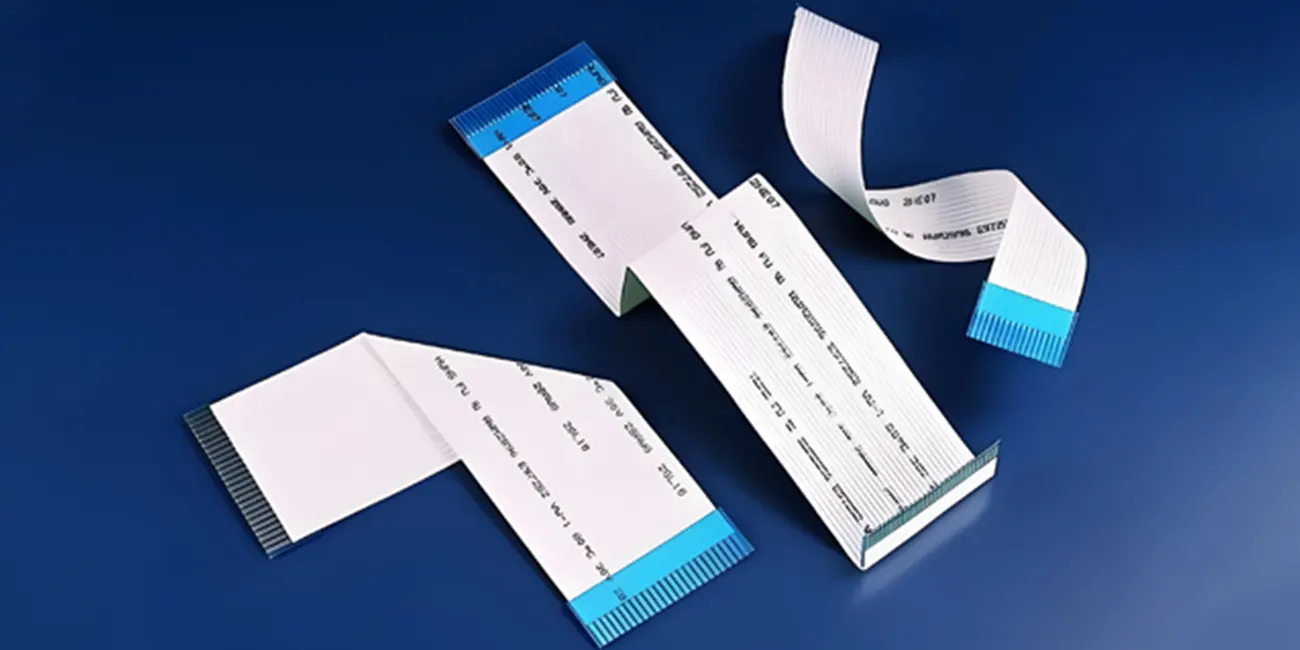
Flexible Flat Cable (FFC) is a type of flexible cable composed of multiple parallel flat conductors covered with insulating material. Due to its high flexibility, space-saving design, and high-density wiring capabilities, FFC has become an indispensable core component in modern electronic products, playing a vital role in consumer electronics, automotive electronics, and industrial automation.
What is a Flexible Flat Cable?
FFC (Flexible Flat Cable) is a type of flexible flat cable composed of tinned copper foil or flat copper wire conductors, with common pitch sizes including:
- 0.5mm
- 1.0 mm
- 1.25 mm
- 2.54 mm
Based on the structural limitations and signal requirements of different electronic products, the appropriate pitch can be selected for the design.

Structural Materials of Flexible Flat Cable
1. Conductor Materials
- Tinned copper foil: oxidation-resistant, easy to solder
- Flat copper wire: supports higher current, more stable
2. Insulation Layer Materials
- Polyester film (PET): High cost-effectiveness, strong mechanical strength
- Silicone: High temperature and oil resistance, suitable for industrial environments
The FFC cable is equipped with reinforcement plates at both ends, which increase the insertion and extraction strength and mechanical stability of the ZIF/LIF connector.
Advantages of Flexible Flat Cables:
- Flexible and bendable: Suitable for moving structures
- Saves internal space: Ideal for thin and lightweight designs
- High-density signal transmission: Suitable for compact electronics
- Lightweight: Lighter than traditional round wires
- Easy to standardise and mass-produce: Low manufacturing cost

Typical application areas of FFC (Flexible Flat Cable):
1. Printers/Scanners/Copiers
Used for signal transmission in sliding and folding structures, such as print head connection cables.
2. Consumer Electronics
Internal wiring in devices such as LCD screens, audio systems, and small home appliances.
3. Smartphones and Tablets
Ultra-thin interconnections between the motherboard, camera, and battery module.
4. Automotive Electronic Systems
Used for high-density communication requirements in BMS, battery modules, infotainment systems, etc.
5. Industrial Automation and Robotics
Suitable for applications requiring frequent movement, such as linear stages and robotic arms.

FAQ (Frequently Asked Questions)
1. What are the differences between FFC and FPC?
FFC (Flexible Flat Cable) is a flexible flat cable composed of flat copper conductors and an insulating layer, characterised by its simple structure and low cost.
FPC (Flexible Printed Circuit), on the other hand, involves etching copper traces onto a flexible substrate, allowing for more complex wiring and three-dimensional folding.
2. What are the common pitches (spacing) for FFC cables?
The most common pitches include:
- 0.5mm
- 1.0mm
- 1.25mm
- 2.54mm
Smaller spacing is used for higher-density signal routing, such as in the internal connections of mobile phones and displays.
3. Can FFCs transmit power?
Yes, but please note:
- The conductor width and thickness must meet the current requirements.
- Voltage drop must be considered over long distances.
- For high currents, it is recommended to use wider conductors or multiple conductors in parallel.
In BMS and battery modules, FFCs are increasingly being used for low to medium-power transmission.
4. Can FFCs be repeatedly bent? What is their lifespan?
FFCs are inherently flexible and suitable for repeated bending, but their lifespan depends on:
- Bending radius (larger radius means greater durability)
- Conductor material
- Whether they are used in a dynamic bending environment
Industrial-grade FFCs, with proper design, can achieve a bending lifespan of tens of thousands to hundreds of thousands of cycles.
5. What precautions should be taken when installing FFC cables?
- Avoid sharp bends.
- Avoid direct pressure or squeezing.
- Ensure the connector latch is fully locked.
- Avoid proximity to heat sources or high-pressure areas.
Proper installation significantly improves equipment stability.
6. Can FFC cables be customised in length or number of pins?
Absolutely, most factories support:
- Custom lengths
- Custom number of pins
- Custom pitch
- Custom reinforcement plate styles
If you need a customised wire harness, please contact a WIRE HARNESS ASSEMBLY factory.
7. Does FFC support high-speed signal transmission?
Yes, but with the following conditions:
- The conductor impedance must be consistent.
- The material needs to be a low-dielectric constant insulating layer.
- High manufacturing precision is required.
Common applications include camera MIPI and LCD LVDS signals.
8. Which industries most frequently use FFCs?
- Mobile phones, tablets, and laptops
- Automotive electronics and electric vehicle battery systems
- Printers and office equipment
- Home appliances
- Robotics and industrial automation systems
Almost all devices that require lightweight and miniaturised components rely on FFCs.
Summary
Flexible Flat Cables (FFCs), with their thin and lightweight structure, high flexibility, high-density wiring capabilities, and customizable features, have become a key component in cross-industry connectivity solutions. From consumer electronics and automotive electronics to industrial automation, FFCs provide stable, reliable, and space-saving signal and power transmission capabilities.
If you are looking for a cable solution suitable for confined spaces, high-frequency bending, or high-density connections, FFCs are a very worthwhile option to consider.