Wire harness manufacturing is more than connecting wires. It involves engineering review, material verification, wire processing, termination, assembly, and quality validation. Each stage must conform to the product drawing and the agreed process requirements.
This guide explains the main stages of wire harness manufacturing, the key controls used at each stage, and the information buyers should prepare when requesting a quotation. The actual steps and their order vary with the harness design, connector type, and customer specifications, so the flow below is a general overview rather than a fixed rule.
Wire Harness Manufacturing Process at a Glance
Illustrative flow. The actual sequence depends on the harness structure, connector type, customer specification, and manufacturing process. Supplementary operations such as pre-terminated leads, shielding, potting, or overmolding can change where a stage occurs.
1. Engineering Review and Production Planning
Before production starts, the factory must confirm what is actually being built. This begins with reviewing the drawing, the bill of materials (BOM), wire length and gauge, connector part numbers, and terminal specifications. The review also clarifies the electrical, environmental, and installation requirements, along with any special processes called for by the design.
During this stage the factory identifies what the product needs in terms of crimping, shielding, sealing, branching, and testing, and determines the tooling, equipment, inspection methods, and test procedures required to build it correctly.
For buyers, this explains why a quotation and a production run cannot be based on a picture alone, and why incomplete design information raises the risk of rework later. A drawing that specifies materials, dimensions, and acceptance criteria supports a clearer quote and a smoother build.
2. Material Preparation and Verification
Production depends on having the right materials: wire, terminals, connectors, seals, sleeving, cable ties, and other accessories. The purpose of this stage is not simply to collect these items but to confirm that they match the BOM and purchasing requirements.
Key checks include verifying part numbers, specifications, and quantities; confirming that each terminal is compatible with the specified wire gauge; and managing material identification, batch information, and storage conditions according to requirements.
Material errors cause assembly mismatches, electrical performance problems, and production delays. Verifying materials up front prevents small mistakes from becoming rework further down the line.
3. Wire Cutting and Stripping
Cutting and stripping prepare each wire for termination. Wires are cut to the dimensions specified in the drawing or work instruction, and the specified length of insulation is removed to expose the conductor.
Because this stage sets the dimensional baseline for the whole harness, the following points matter:
|
Control point
|
Why it is controlled
|
|---|---|
|
Wire length
|
Cut wires to the dimensions in the drawing or work instruction, and verify the cutting process against the required tolerance during first-piece inspection.
|
|
Strip length
|
Set the stripping length to suit the specified terminal and termination method. Incorrect stripping can result in incomplete conductor engagement or excessive exposed conductor.
|
|
Conductor condition
|
Inspect stripped ends for cut, nicked, missing, or damaged strands against the applicable workmanship requirements.
|
|
Wire identification
|
Confirm that wire type, color, or marking matches the drawing before it enters termination.
|
|
First-piece verification
|
Check initial samples before continuing production, and adjust equipment if measured results fall outside the specified limits.
|
Cutting and stripping are not just dimensional processing. The quality of the stripped end directly affects how reliably the wire can be terminated and assembled.

4. Wire Termination: Crimping, Soldering and Other Methods
Termination creates the electrical and mechanical connection between the wire conductor and the terminal. Crimping is the most common method for industrial and automotive harnesses. Its quality depends on the compatibility of the wire, terminal, and crimp tooling, as well as controlled process settings.
Key control points include verifying that the terminal, wire size, applicator, and tooling are compatible; monitoring crimp dimensions and other specified process parameters; and inspecting conductor engagement, insulation support, and terminal condition against the applicable workmanship criteria. Pull-force testing or other validation should be performed at the frequency and acceptance limits required by the control plan, terminal specification, or customer requirements.
Visual inspection alone is not enough to confirm crimp quality. Dimensional and mechanical checks, and where required destructive testing, provide the evidence that the joint will hold under service conditions.
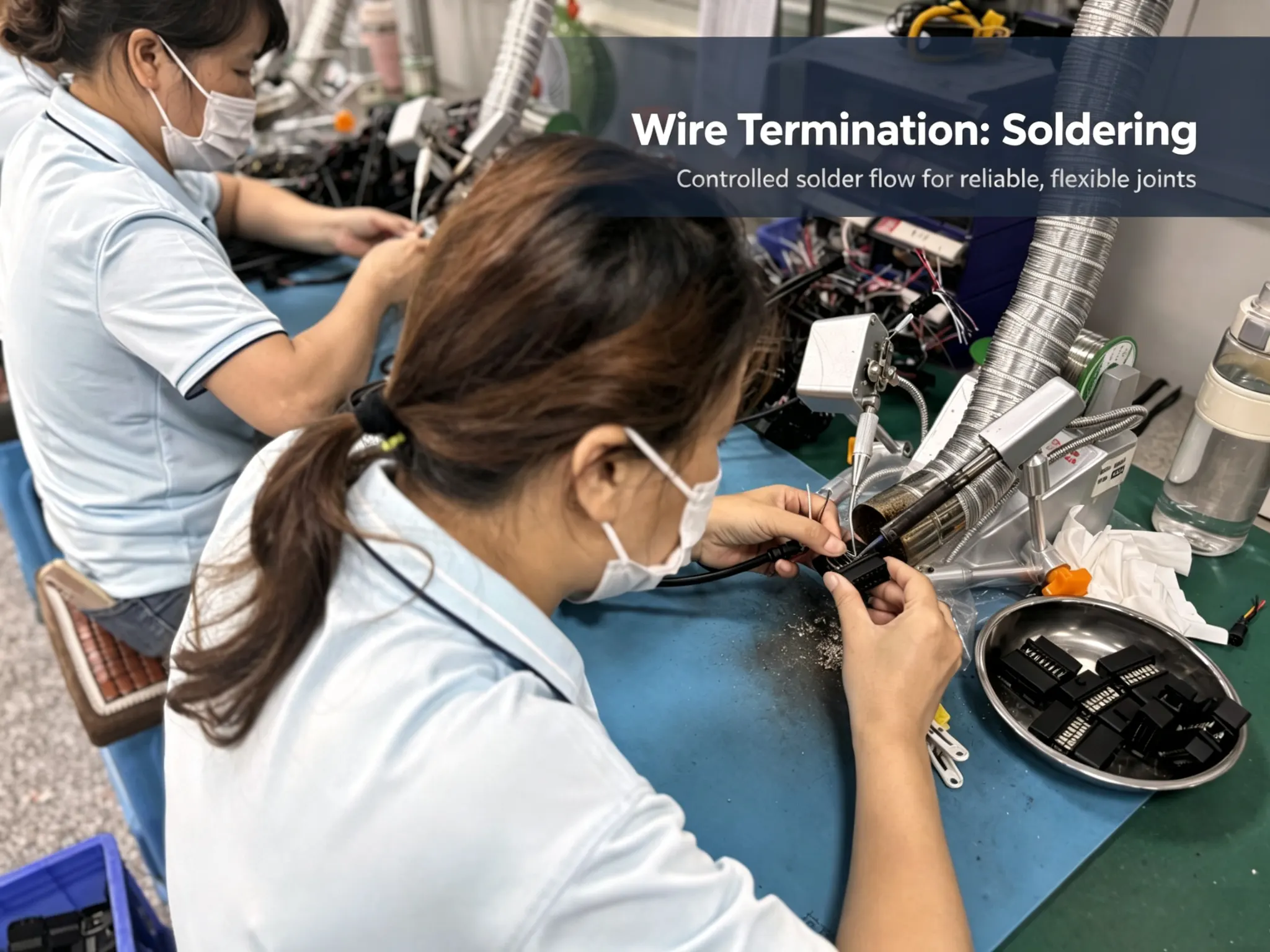
Soldering may be used where the design and applicable requirements permit it. The process must control solder flow and other factors that could affect flexibility, insulation, and long-term mechanical performance. Other termination methods are selected according to the connector design and customer specification.
5. Connector Assembly and Harness Routing
In this stage the terminated leads are assembled into the harness. Terminals are inserted into the connector housing and their locked position is confirmed. Wires are routed according to the drawing, including their branches and connection positions, and any specified seals, sleeves, conduit, braid, ties, or other attachments are installed.
Mechanical requirements such as stress relief, bend space, and fixing points are handled as the design requires. For products with waterproof, dust, or shielding requirements, the corresponding structure must comply with the product specification.
Assembly follows the drawing and the work instructions: apply tape, conduit, sleeving, heat-shrink tubing, clips, and strain-relief features as specified, and verify branch dimensions, terminal seating, connector locking, and mechanical protection against the approved design.
Not all harnesses are built the same way. A simple cable assembly and a complex multi-branch harness have different routing and assembly requirements, and the drawing dictates what applies. A correct electrical connection does not mean the assembly is complete: mechanical structure, routing, and connector locking are equally important.
6. In-Process Inspection and Assembly Verification
Quality control does not start at the final test. In-process inspection catches mechanical and workmanship defects while the harness is being built, so that issues are corrected before they compound.
Typical checks include first-article inspection and confirmation of key dimensions, terminal position and connector locking, wire length and branch dimensions, and process checks on critical operations such as crimping. Sampling or other specified inspection is applied according to risk, process characteristics, and customer requirements.
The inspection items, sampling ratios, and acceptance criteria are determined by the applicable product specification and the quality plan, not by a single fixed rule.
7. Final Electrical Testing and Quality Release
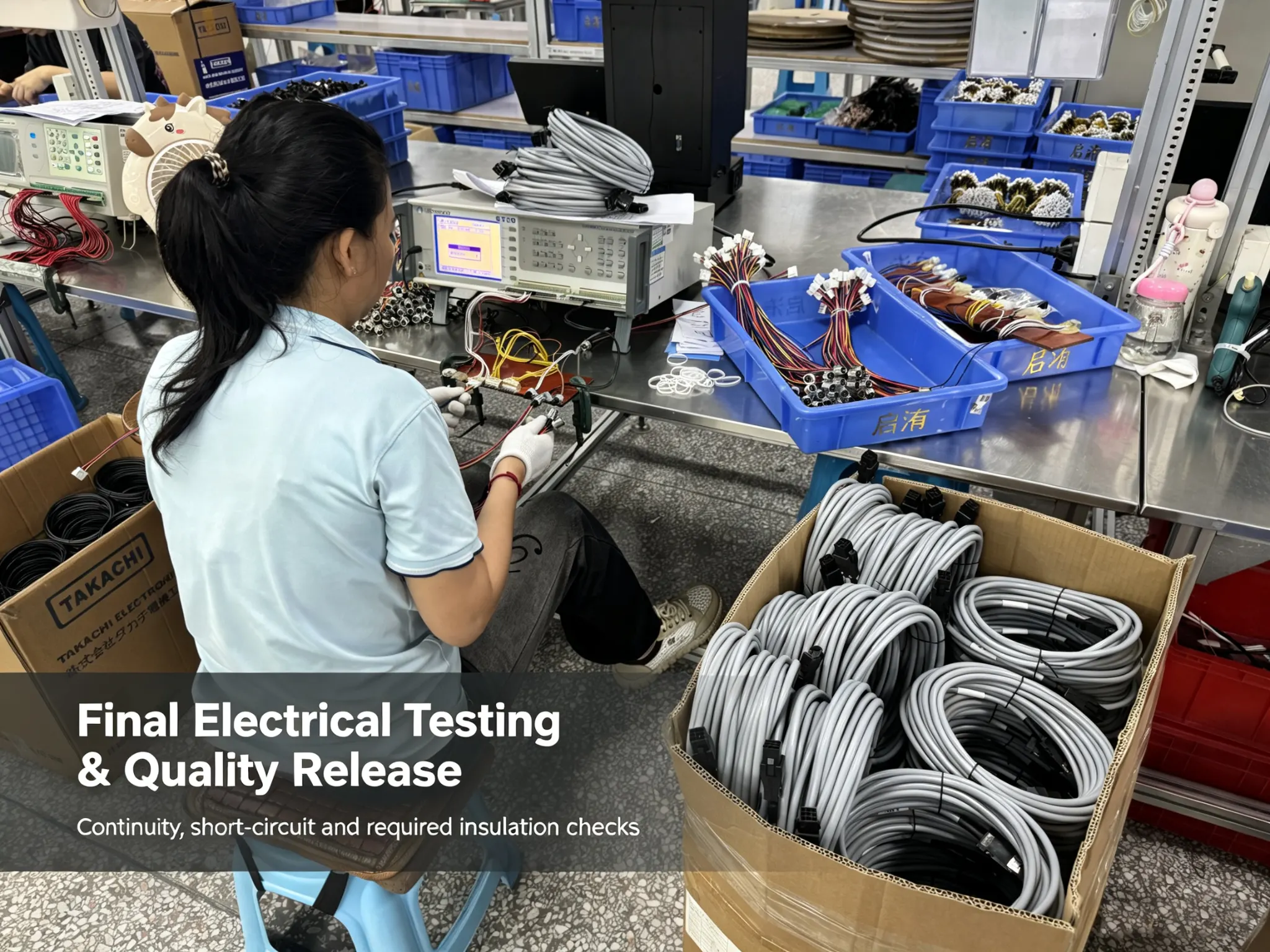
Electrical testing verifies that the finished assembly meets its specified electrical requirements. The test method and coverage depend on the harness design, applicable standards, and customer specification.
-
Continuity testing confirms that intended circuits are connected and can identify open circuits or incorrect connections within the test fixture's coverage.
-
Short-circuit testing detects unintended connections between circuits that should remain electrically isolated.
-
Insulation resistance testing measures resistance between specified conductors or between conductors and other designated test points, when required.
-
Dielectric withstand testing (Hi-Pot) applies a specified test voltage to verify insulation withstand capability when required by the product specification or applicable safety requirements.
Not every wire harness requires all four tests. Test voltage, duration, acceptance limits, circuit coverage, and record requirements must be defined before production. Assemblies containing electronic components or other voltage-sensitive devices may require special test arrangements. Where 100% electrical testing is specified, each finished unit must receive the required tests and meet the corresponding acceptance criteria before release.
Passing a continuity test does not mean the whole harness is verified. Routine electrical testing does not by itself prove waterproofing, mechanical strength, long-term durability, or high-speed signal performance.
Final inspection and release cover the aspects electrical testing cannot: appearance, dimensions, connectors, and attachments are checked, identification and quantity are matched against the order, and test results and required inspection records are confirmed before the assembly is released.
8. Documentation, Packaging and Shipment
The final stage manages release and delivery. Test and inspection records are saved according to requirements, and the product label, quantity, version, and order information are confirmed. Packaging is selected to suit the shipping and storage requirements.
9. What Can Affect Wire Harness Production Time and Quality?
Several factors influence how long a harness takes to produce and how difficult it is to control:
|
Factor
|
Possible impact
|
|---|---|
|
Incomplete drawings or BOM
|
Requires additional clarification and affects production preparation.
|
|
Special terminals or connectors
|
May require dedicated tooling or extra process confirmation.
|
|
Complex branching and routing
|
Adds assembly and dimensional inspection work.
|
|
Sealing, shielding, or overmolding
|
Adds specific processes and their corresponding verification.
|
|
Additional testing requirements
|
Adds test preparation, execution, and recording work.
|
There is no single lead time or cost ratio that applies to every harness. The actual effect depends on product structure, order quantity, tooling readiness, and inspection requirements. Understanding these factors helps buyers interpret quotation and lead time differences, and helps engineers identify process risk earlier.
10. What to Provide When Requesting a Custom Wire Harness
To get a useful quotation and an accurate build, provide the supplier with the following where available:
-
The latest version of the drawing or wiring diagram.
-
A BOM or the specified wire, terminal, and connector part numbers.
-
Wire length, branch dimensions, and other key dimensional requirements.
-
Electrical, environmental, and mechanical requirements.
-
Applicable testing, inspection, and certification requirements.
-
Estimated quantity, sample needs, and target delivery time.
If a complete drawing is not available, provide an existing drawing, a reference sample, or the known specifications, and let the engineering team identify the additional information needed to confirm the production scope and quotation.
Frequently Asked Questions
How long does it take to manufacture a wire harness?
Lead time depends on material availability, harness complexity, order quantity, tooling requirements, and inspection needs. Standard components may shorten procurement time, while custom connectors or molded parts can extend it. Production timing should be confirmed after reviewing the drawing, BOM, quantity, and required tests.
Does every wire harness require the same manufacturing steps?
No. The core cutting, stripping, termination, assembly, and testing steps are consistent across assemblies, but supplementary operations vary widely. Shielded cable processing, potting, overmolding, and custom fixtures add stages and can change the production sequence. The process flow is tailored to the drawing and technical specification.
Is every wire harness electrically tested before shipment?
Electrical testing requirements depend on the product specification, applicable standards, and customer agreement. Continuity and short-circuit checks are commonly used to verify circuit connections. Insulation resistance, dielectric withstand, and other tests are performed when required by the design or applicable requirements. Buyers should confirm the test scope, acceptance limits, and documentation requirements before production.
What is the difference between in-process inspection and final testing?
In-process inspection covers dimensional checks, crimp quality, routing geometry, and visual workmanship during assembly, so mechanical defects are caught early. Final testing focuses on electrical performance, verifying circuit connectivity and insulation integrity. The two layers work together to eliminate both mechanical and electrical failures.
Conclusion
Raw wire and individual components are converted into finished wire harness assemblies through a controlled sequence of engineering review, material verification, wire processing, termination, assembly, inspection, and testing. The specific process steps, tooling, and acceptance criteria are determined by the harness design, the end-use industry, and the applicable standards and customer requirements.
For a deeper look at individual topics, see our articles on crimp quality, wire harness testing, DFM guidelines, wire gauge selection, and connector selection. If you have a custom wire harness requirement, submit your drawings, BOM, or reference sample and the engineering team will confirm the remaining details and provide a quotation.