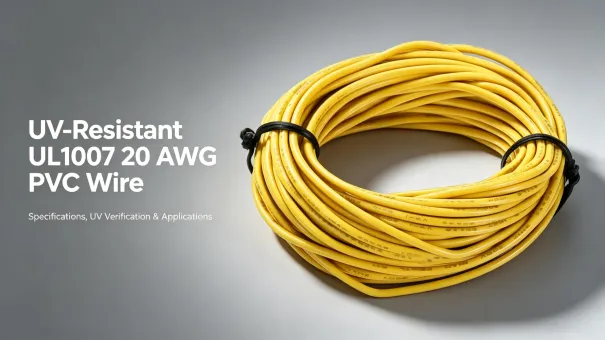
UL Style 1007 is a widely used Appliance Wiring Material (AWM) designation for internal equipment wiring. The 20 AWG size is used in various wiring applications, but its suitability for a particular circuit depends on the required current capacity, installation conditions, and applicable equipment requirements. UL Style 1007 defines the corresponding wire construction and performance requirements, but UV resistance must be confirmed based on the specific product's recognition information and supporting test documentation.
This article serves as a technical specification breakdown and engineering selection guide for UV-modified UL1007 20 AWG PVC wire. It helps design engineers, procurement staff and harness manufacturers clarify three core questions: what the formal UL1007 rating covers, how to verify valid sunlight resistance performance, and what conditions must be confirmed before specifying this wire for sun-exposed environments.
Product Overview: UV-Resistant UL1007 20 AWG Wire
UL Style 1007 is defined under UL 758 AWM standards for single-core internal wiring with extruded PVC insulation. The three core identifiers are independent and must be verified separately:
- UL1007: The wire style number governing electrical ratings, insulation thickness and flame performance for appliance internal wiring.
- 20 AWG: American Wire Gauge size, with a nominal cross-sectional area of approximately 0.52 mm². It is available in solid or stranded copper conductors.
- PVC Insulation: Polyvinyl chloride insulation material. UV resistance varies by PVC compound formulation; it cannot be judged solely from the material name.
💡 Critical reminder: The UL1007 style certification does not automatically grant UV resistance. UV protection depends on the specific insulation compound formulation and must be supported by applicable recognition information or test evidence.
Technical Specifications of UL1007 20 AWG PVC Wire
Note: The table below lists baseline reference parameters. Exact conductor stranding, outer diameter, temperature range and UV performance must follow the manufacturer's official datasheet and the specific product's UL recognition record.
| Parameter | Reference / Verification Required |
|---|---|
| Wire Style | UL Style 1007 (UL 758 AWM) — confirm in UL recognition record |
| Wire Gauge | 20 AWG |
| Conductor Material | Bare copper or tinned copper — confirm with supplier |
| Conductor Construction | Solid or stranded; exact stranding count per manufacturer drawing |
| Insulation Material | PVC; UV resistance depends on specific compound formulation |
| Rated Voltage | Typically 300 V AC — verify on product datasheet and UL record |
| Rated Temperature | Typically 80°C continuous — verify exact range on product documentation |
| Nominal Outer Diameter | Per manufacturer drawing and insulation wall thickness |
| Flame Performance | Verify the applicable flame test classification and any required markings against the specific product's current UL recognition record. Do not assume a VW-1 rating unless it is explicitly documented. |
| UV Resistance | Not covered by basic UL1007 certification; requires separate product-level evidence |
UV Resistance and Performance Verification
UL1007 Rating vs. UV Resistance
UL1007 identifies a wire style, but the style designation alone does not establish that a specific product is sunlight-resistant. Buyers should review the manufacturer's datasheet, applicable UL recognition information, and supporting test documentation for the exact wire construction.
UL's cable recognition guidelines treat sunlight resistance as a separate product evaluation item, not an automatic property of all wire styles. The insulation compound, wire construction, and end-product recognition must all be checked independently.
Test Method and Acceptance Criteria
The required exposure duration and acceptance criteria depend on the applicable standard edition and the specific wire product's qualification records. Relevant test documentation should identify the test method, exposure conditions, duration, and measured properties before and after aging.
Some UL758 requirements for sunlight-resistant wire and cable have specified accelerated weathering procedures and mechanical-property retention criteria. However, the applicable requirements must be confirmed against the relevant standard edition and product documentation rather than assumed to apply uniformly to every UL1007 wire.
Accelerated aging under defined laboratory conditions does not directly establish outdoor service life. Actual performance depends on UV intensity, temperature cycling, moisture, installation method, and other environmental factors. Do not infer a specific service life from the test duration alone.
What Happens When PVC Wire Is Used Beyond Its Verified Environment?
Prolonged UV exposure can cause PVC insulation to age, leading to surface chalking, loss of elasticity, and reduced mechanical strength over time. The actual rate and severity depend on the specific compound formulation, exposure intensity, and duration. Without product-level test data, it is not possible to predict a fixed service life or specific performance degradation percentage for a given application.
Applications and Environmental Considerations
Suitable applications should be determined based on the documented UV resistance evidence, equipment standards, and installation conditions — not from the wire style number alone.
Application Environments and Conditions to Verify
| Application Environment | Conditions to Confirm |
|---|---|
| Electronic equipment internal wiring | Voltage, temperature, and insulation requirements of the end product |
| Control cabinets and machinery | Applicable equipment standards, routing method, ambient temperature |
| Sun-exposed equipment interior or exterior | Actual UV exposure level, installation location, and documented UV resistance evidence |
| Outdoor long-duration harnesses | Sunlight, moisture, temperature cycling, and full harness environmental suitability |
Important note: Single-wire performance does not automatically extend to complete harnesses. Connectors, heat-shrink tubing, cable jackets and seals may have different UV resistance. Full system-level environmental testing is required for outdoor assemblies.
Wire Selection and Installation Considerations
- Electrical Ratings: Confirm operating voltage and continuous temperature against the specific product datasheet. Derate ampacity when wiring is bundled inside closed enclosures with limited heat dissipation.
- UV Exposure Control: Documented UV resistance applies only within the tested range. For fully open outdoor installations, verify whether the product's recognition covers the expected exposure conditions, or consider additional outer jacketing.
- Mechanical Requirements: Select stranded conductors for applications involving repeated flexing or vibration; solid conductors are suitable for fixed stationary wiring.
- Environmental Limits: Check datasheet for chemical resistance, oil resistance and other environmental compatibility requirements before specifying for industrial environments.
Quality Documentation and Product Verification
Before approving this wire for a project, collect and cross-check the following documents from the supplier:
- UL recognition record confirming the specific wire style and construction.
- Full technical datasheet listing conductor stranding, insulation thickness, finished outer diameter, voltage and temperature ratings.
- Test documentation or certification records supporting the UV resistance claim, including the applicable standard, test method, exposure conditions and results.
- RoHS compliance documents and batch traceability records. RoHS compliance is a separate environmental requirement and cannot be used as proof of UV resistance.
- When the insulation compound falls under a recognized UL material category, verify that the finished wire product's recognition record covers the declared sunlight resistance. A material-level recognition does not by itself guarantee that the finished wire has passed the corresponding end-product evaluation.
Whether a third-party laboratory report is required depends on project specifications, industry standards and customer requirements. For regulated or safety-critical applications, independent third-party verification may be advisable.
Frequently Asked Questions
Q1: Is all UL1007 wire UV-resistant?
A: No. The base UL1007 style standard does not include UV resistance requirements. Only specific product variants with appropriate compound formulations and documented test evidence can be considered sunlight-resistant. Long-term UV exposure may cause PVC insulation aging, and the actual degree depends on formulation, exposure conditions and duration.
Q2: What is the rated voltage and temperature of UL1007 20 AWG wire?
A: Typical UL1007 20 AWG wire is rated for 300 V AC and 80°C continuous operation, but exact ratings must be confirmed on the specific product's datasheet and UL recognition record. Temperature and voltage ratings can vary by manufacturer and construction.
Q3: Can UL1007 wire be used outdoors?
A: It depends on the specific product's environmental suitability, documented sunlight resistance evidence, and the requirements of the end equipment. The UL1007 style designation alone does not determine outdoor suitability. Always verify the product's recognition information and test documentation before outdoor application.
Q4: What should I check before specifying UV-resistant 20 AWG wire?
A: Confirm the exact wire model and UL recognition record, conductor construction and dimensions, voltage/temperature ratings, and the UV resistance test documentation (standard, method, exposure conditions, and acceptance results). Also verify whether the tested performance matches the project's actual environmental and installation requirements.