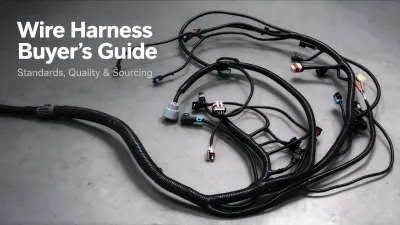
The engine harness is the highest-risk assembly in a vehicle's electrical system: it wraps around machinery that combines extreme heat, aggressive fluids and relentless vibration, while its failures are among the most expensive to diagnose. This analysis looks at the engine harness as a system — from thermal physics to failure statistics to manufacturing quality gates.
Thermal Reality and Material Response
An engine bay is not one temperature; it is a landscape. Intake-side surfaces run warm while exhaust and turbo regions exceed 200°C at the surface, and heat-soak after shutdown can push stagnate zones above anything seen while driving. Materials respond in layers: cross-linked insulation (XLPE) for general zones, silicone and PTFE for hot sections, reflective or fiberglass sleeving against radiant sources, and — often overlooked — spacing as a material: 25 mm of air outperforms most sleeving. Harness drawings that encode temperature zones by route position, not by 'engine bay' globally, are the ones that age well.
Fluids: The Slow Attack
Oil, fuel, coolant and battery acid each attack insulation differently — swelling, plasticizer extraction, embrittlement. The harness design response is contact avoidance: routing above fluid paths, drip loops at every vertical transition, and jacket materials chosen for the specific fluids on each route segment. A harness that is 'oil resistant' generically still has a worst-case segment; the analysis lies in knowing which segment.
Vibration and Motion
Engines move on their mounts; body structure does not. The harness must absorb this differential every drive cycle. Failures concentrate at three points: rigid clamps on both sides of an engine-body crossing (a taut span work-hardens copper strands until they fracture), connectors lacking positive locks (vibration micro-motions wear plating until intermittents appear), and rub points where the loom touches anything (abrasion through insulation, then a short to ground). Design answers — service loops, positive-lock housings, abrasion armor at every contact point — are cheap at design time and priceless in warranty.
Connector Systems and Sensor Circuits
Engine sensors (crank, cam, knock, lambda, MAP) produce low-level signals whose integrity depends entirely on connection quality and noise control. Their connectors need sealed, temperature-rated housings with gold or premium tin plating for low-level signals, and their routing keeps them away from ignition and injector harnesses. Our analysis of poor connector detection details why marginal contacts present as impossible-to-reproduce misfires.
Common Failure Modes in Service
- Heat-embrittled insulation cracking at the hottest clamp points, years after build.
- Rodent damage where soy-based insulation attractants were used — a modern industry lesson now addressed by additive chemistry.
- Connector seal loss after aggressive engine cleaning, letting water into low-level circuits.
- Copper strand fracture at unrelieved engine-body crossings.
Manufacturing Quality Gates
Production engine harnesses require crimp-height control with per-setup records, pull-force sampling, 100% electrical test, hipot verification and routing-shape verification against the form board. Suppliers serving engine programs should document all of it; Kaweei does, supporting engine harness programs from prototype to volume. Contact our team with your drawings, and see our engine bay design guide for zone-by-zone material selection.