Every machine that uses electricity uses wire harnesses — and most people who buy them have never been offered the fundamentals in one place. This guide is that place: what a harness is, how it's built, what makes one good, and what a buyer should know to specify one.
What a Wire Harness Is — and Why It Exists
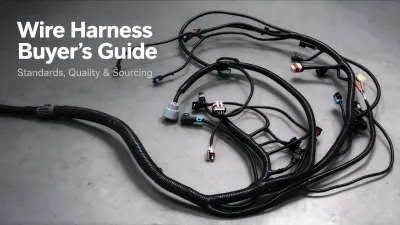
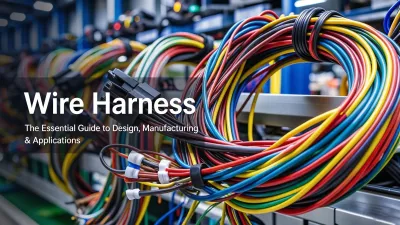
A wire harness is a pre-assembled bundle of wires, terminations and connectors, built to a drawing so that a machine's electrical connections arrive as one installable unit instead of hundreds of loose wires. The reasons are practical: assembly speed (one harness installs faster than wires individually run), reliability (factory-built terminations beat field wiring), consistency (every unit identical), and serviceability (labeled, organized circuits that technicians can trace). Everything else in this guide elaborates those four reasons.
The Anatomy
- Wire: conductor (copper, aluminum, gauge) plus insulation (material and temperature class per zone) — the wire selection guide covers the families.
- Terminations: crimps (the dominant method — quality is a tooling and process discipline), solder joints, IDC, ultrasonic welds for splices.
- Connectors: the interface points — selected per our connector framework for load, environment, cycles and EMC.
- Protection and organization: tape, loom, conduit and sleeving; heat shrink at joints; labels for service.
- The drawing: wire list, routing diagram, termination table — the harness's legal definition.
How One Gets Built
The production flow (detailed in our manufacturing process guide): wire cutting and stripping → terminal crimping (with force monitoring) → sub-assembly and connector insertion → harness forming on a board (the full-scale layout that fixes geometry) → taping and protection → electrical test (100%) → inspection and packing. Each step has its quality discipline; the harness is only as good as the weakest step's control.
What Makes a Harness Good
Four properties, verifiable rather than claimed: electrical correctness (100% tested against the pin map — no sampling tiers), termination integrity (crimp cross-sections and force data, not vibes), mechanical fitness (strain relief, routing fitment, bend radius respected), and documentation (the records that let you audit what you bought). A supplier who can show data for all four is a manufacturer; one who shows samples is a gambler.
What a Buyer Should Know
- The drawing is the contract: ambiguous drawings produce ambiguous harnesses — DFM feedback exists to remove ambiguity before production.
- Environment drives cost: sealing, temperature class and flex duty are the expensive requirements; specifying them honestly is cheaper than failing them.
- Volume changes everything: prototypes cost more per unit — that's tooling and setup amortized over one piece, not gouging.
- Standards exist per application: automotive, medical, UL and IPC frameworks each set requirements — know which one governs your program.
Kaweei as Your Harness Partner
Kaweei manufactures custom wire harnesses across automotive, industrial, medical and new-energy applications — engineering support, monitored production, full testing and documentation from our Dongguan facility. Contact our engineering team with your drawing or application; for the production details, our manufacturing process guide shows the flow step by step.