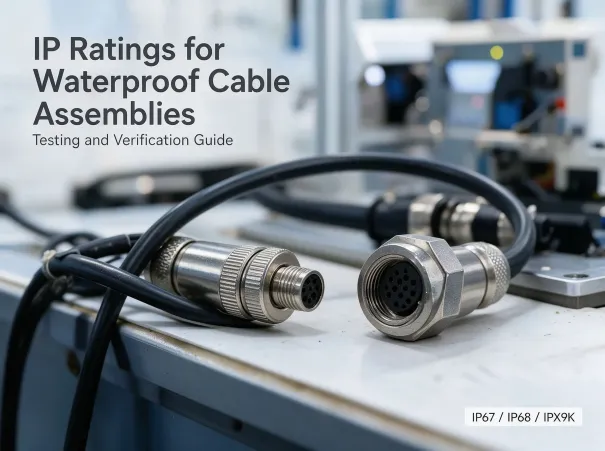
A waterproof cable assembly is only as reliable as its verified sealing performance. An IP rating describes protection under strictly defined test conditions, but validity always hinges on the tested assembly configuration, selected standard, and written acceptance criteria.
For cable assembly buyers and design engineers, the core problem is not simply checking whether a product is marked IP67 or IP68. The real question is whether the tested sample matches your field application, and whether the provided test evidence fully supports the claimed ingress protection level.
This guide focuses entirely on IP rating verification, test method limitations, result judgement rules, and supplier document qualification. It avoids repeating content about seal design, material selection, or harness manufacturing — those topics are covered in our dedicated waterproof assembly and sealed connector articles.
What Does an IP Rating Actually Verify?
Understanding the IP Code & Tested Configuration
The IP (Ingress Protection) code uses two digits: the first digit defines dust protection, and the second defines liquid water protection. The letter X indicates that a characteristic has not been assigned a numerical rating in that position; it does not automatically mean zero protection against solids or water.
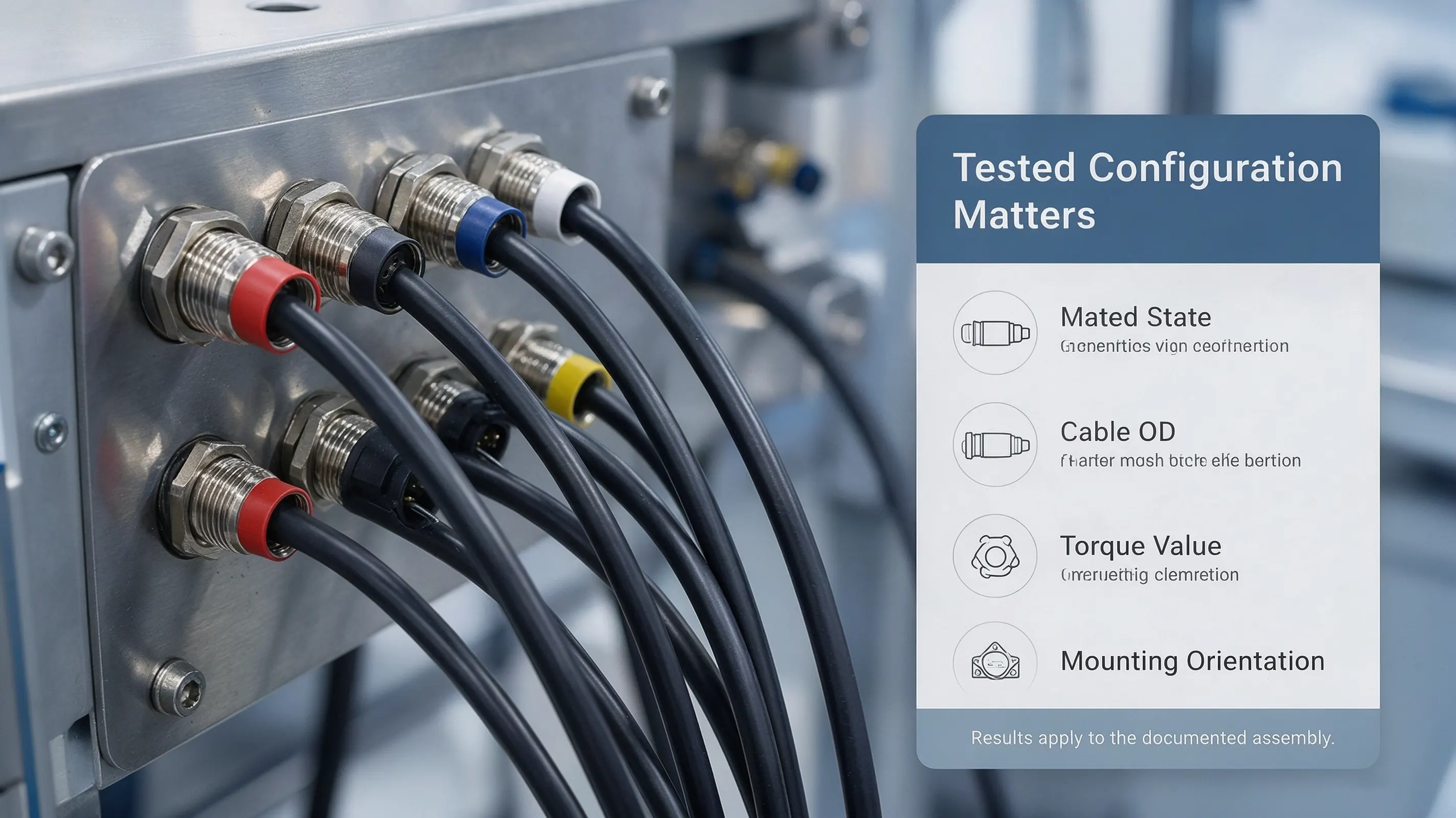
IEC 60529 defines IP ratings for protection provided by electrical equipment enclosures. An IP rating applies to the product or assembly only under the exact configuration covered by the test programme. Test results apply to the tested configuration plus product variants formally justified in the verification plan. Changes to connectors, cable outer diameter, sealing hardware, mounting orientation, or assembly procedure may require additional testing to maintain rating validity.
A connector’s datasheet IP rating cannot be automatically extended to a complete cable assembly unless the full mated, sealed harness is independently verified under identical test conditions.
IP67 vs IP68: Clarify Test Conditions Under IEC 60529
Both IP67 and IP68 carry a dust-tight rating, but their immersion test rules differ significantly:
- IP67 (Temporary Immersion) IPX7 specifies temporary submersion under defined conditions. For most standard-sized enclosures, testing is carried out at 1 m water depth for 30 minutes, following the full text of IEC 60529:1989+A1:1999+A2:2013. The acceptance criteria must follow the applicable standard and product requirements. Water ingress should be assessed according to the specified test conditions and the potential effects on the protected equipment, rather than assuming that every product uses the same pass/fail criteria.
- IP68 (Continuous Immersion) IPX8 applies to immersion conditions more severe than those specified for IPX7. All test parameters — depth, hydrostatic pressure, water temperature and test duration — must be defined in line with the selected standard and formal product requirements. Written test parameters cannot be set arbitrarily only by verbal agreement between buyer and supplier. No universal depth or time requirement exists for all IP68 assemblies; all conditions must be fully documented.
Critical Misconception: An IP68 label does not mean unlimited underwater depth. Always confirm the full written test parameters before approving components for submersible use.
Why Assembly Configuration Changes Affect IP Test Results
Test outcomes are sensitive to every assembly variable:
- Connector mating state (fully mated / capped / unmated)
- Cable outer diameter matched to the gland seal range
- Torque value applied to compression nuts
- Cable exit sealing and strain relief installation
- Free-hanging or panel-mounted test orientation
If a supplier validates a short prototype with oversized cable, but mass production uses wire outside the seal’s OD range, the finished harness may fail immersion testing even if the lab sample passed.
Which Standards Apply to Waterproof Cable Assembly IP Testing?
Two commonly referenced standards for enclosure ingress protection are IEC 60529 and ISO 20653. The applicable standard is determined by the equipment type and application, and test results from one standard cannot be automatically accepted as proof of compliance with the other.
IEC 60529: Enclosure Protection for General Industrial Harnesses
This is the baseline global standard for degrees of protection provided by electrical equipment enclosures. It sets IPX7/IPX8 immersion and IPX5/IPX6 water jet test protocols for industrial, marine, and machinery cable assemblies. It remains the default unless automotive specifications are written into the project scope.
ISO 20653:2023: Road Vehicle-Specific IP Requirements
This standard applies exclusively to enclosures of electrical equipment for road vehicles. It adopts the base IP code framework from IEC 60529 but adds K-suffix ratings for automotive washdown scenarios that are not covered in the IEC standard.
Rule to follow: Never cross-certify test results. A test completed to ISO 20653 cannot automatically be accepted as proof of IEC 60529 compliance, and vice versa. Always lock in the standard edition before writing test requirements.
Key Terminology: IPX9 vs IPX9K
IEC 60529 defines IPX9 for high-pressure water jets without the K suffix. ISO 20653 defines IPX9K for high-pressure, high-temperature spray testing unique to road vehicle washdown environments.
The commercial shorthand IP69K is widely used in industry, but formal test reports must list the exact code matching the selected standard to avoid specification gaps. Passing an IPX9K jet test does not satisfy IP67 static immersion requirements. In general, spray jet testing cannot automatically prove immersion protection, and immersion testing cannot prove resistance against high-pressure hot water jets. Additional testing is required if both protection levels are specified.
Common Waterproof Test Methods: Capabilities & Key Limitations
This table clarifies what each test can prove, plus its key limitations, so buyers do not mistake production screening data for formal IP rating validation.
| Test Method | What It Checks | Key Limitation |
|---|---|---|
| Immersion Test | Water ingress under defined submersion depth, pressure and duration (formal IPX7 / IPX8 verification) | Must strictly follow the written test conditions of the selected standard; shortening duration or reducing depth cannot be used to claim the same IP rating. |
| Water Jet Test (IPX5/IPX6 / IPX9 / IPX9K) | Resistance against sprayed or high-temperature high-pressure water streams | Cannot replace immersion testing for IP67/IP68; jet spray resistance does not guarantee protection against static standing water. |
| Air Leak / Pressure Decay Test | Detects gross and fine air leakage across sealing interfaces | Pressure-decay testing can support design validation and production quality control when the method is fully validated for the product. However, a passing air result does not independently prove IP compliance unless the project specification explicitly accepts this method in place of water immersion. |
| Visual Inspection | Checks seal damage, incomplete mating, mismatched cable OD and potting voids | Cannot substitute standardized water ingress testing; visual checks only catch obvious assembly defects, not micro-leaks. |
| Post-Exposure Electrical Test | Verifies continuity and insulation resistance after water exposure | Passing electrical performance does not confirm zero water ingress; trapped moisture may not trigger immediate failure but will cause long-term terminal corrosion. |
Step-by-Step Process to Validate IP Test Results
Pre-Test Documentation & Sample Configuration Control
- Record the full assembly configuration: part number, cable outer diameter, mating torque, mated/capped status, and sample length.
- Lock in the standard full edition (e.g., IEC 60529:1989+A1:1999+A2:2013 or ISO 20653:2023) and document all test parameters: depth, duration, water temperature, hydrostatic pressure.
- Use only calibrated test equipment with valid calibration certificates.
- Document relevant test conditions and results; full continuous video recording is only required when explicitly written into the quality plan.
Post-Test Inspection Rules
Inspect the assembly after exposure strictly according to the written test procedure. If internal cavity inspection is required, document the method of opening the sample and record all visible evidence of water ingress. Do not disassemble sealed joints arbitrarily, as disassembly itself may alter internal moisture conditions and skew results.
Separate IP Ingress Judgement from Electrical Performance Checks
Determine pass or fail strictly against the acceptance criteria defined in the applicable standard and product specification. Record all observed water ingress and assess its location and impact against those written rules.
Evaluate post-test electrical performance separately where required: perform continuity or insulation resistance measurements only when specified in the test plan. Conduct dielectric withstand (hipot) testing only where appropriate for the assembly, to avoid introducing unnecessary electrical stress.
Most Common Causes of IP Waterproof Test Failures
- Improper seal compression: Excessive torque may deform or damage sealing components; insufficient torque fails to achieve full sealing contact pressure.
- Cable outer diameter out of range: If the cable jacket OD falls outside the seal’s designed working range, the elastomer may not build sufficient contact pressure, which may create leakage paths depending on seal structure and installation.
- Incomplete connector mating: Half-locked pin-and-socket connections leave open sealing interfaces that allow water to penetrate the connector housing.
- Potting and encapsulation defects: Air bubbles, incomplete filling, or poor adhesion between potting compound and cable jacket create hidden capillary ingress channels.
- Minor seal damage during assembly: Small cuts or nicks on rubber seals may pass a specific air leak test but become visible failures during immersion. Defect detection depends on test pressure, fixture sensitivity, and the pass/fail threshold set for screening.
What Documentation Should Buyers Request from Suppliers?
Three Types of Test Documents
- Supplier test report: Records the supplier's tested sample, test conditions, results, and pass/fail assessment. It is internal test evidence unless independently issued or verified by an external party.
- Third-party laboratory report: Documents testing performed by an external laboratory. Verify the laboratory’s competence or accreditation scope, the tested product identification, and the report's scope. Accreditation is only mandatory when required by contract or project quality rules.
- Certificate or declaration of conformity: A certificate is issued by the relevant certification body where applicable; a declaration of conformity is a signed statement made by the manufacturer taking formal responsibility for compliance. Check the issuing party, covered product, applicable standard, and stated scope before relying on either document.
Do not treat internal supplier test reports as equivalent to independent third-party certification; document requirements always follow contract terms and project quality specifications.
Traceable Test Report Checklist for IP Qualification
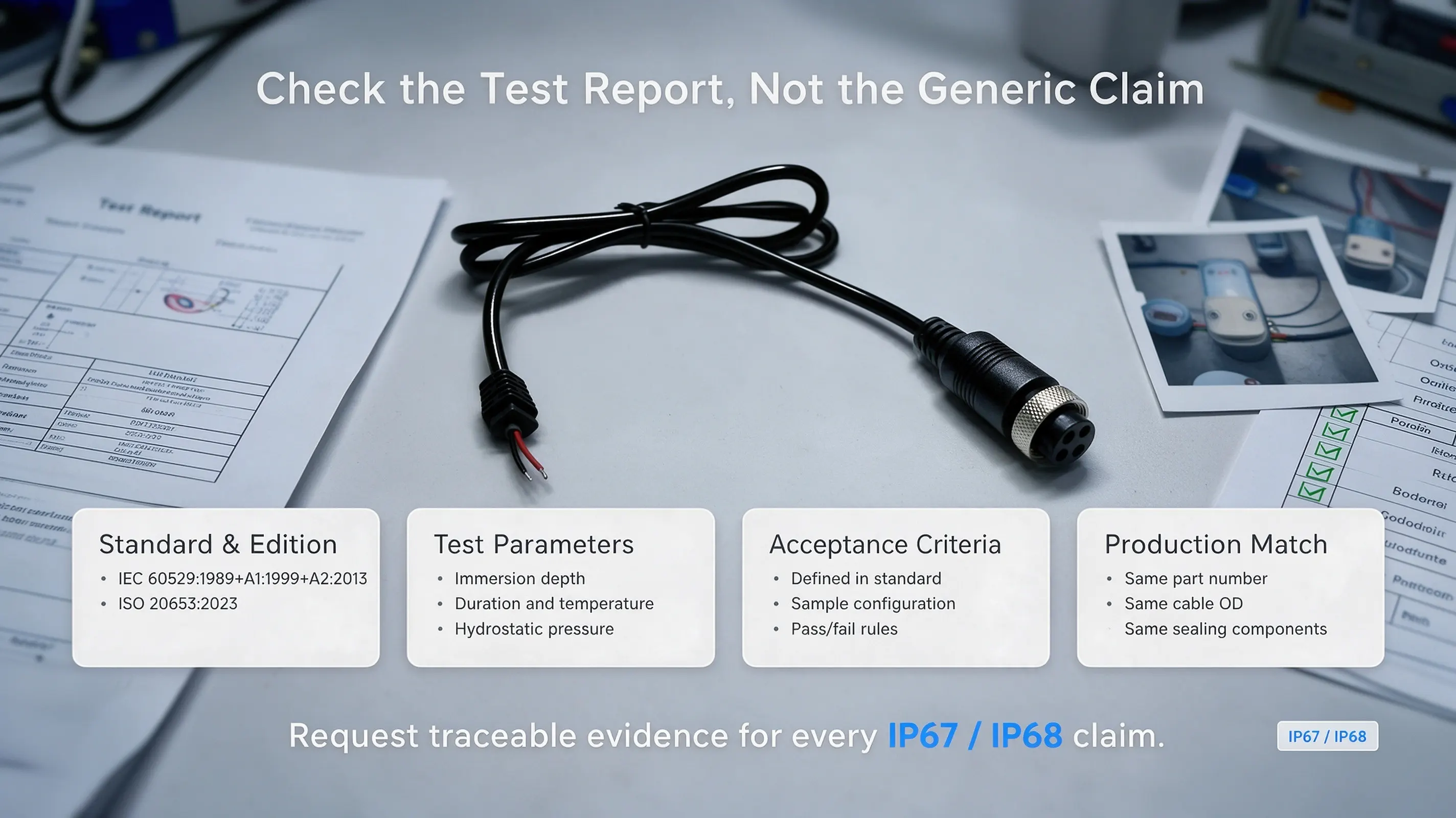
- Full standard identifier with complete edition number
- Exact tested product configuration: mating state, cable size, torque values, mounting orientation
- Written test conditions (immersion depth, duration, temperature, hydrostatic pressure, especially for IP68)
- Complete test report including results, acceptance criteria, deviations, plus supporting inspection photos where available
- Confirmation that the tested sample matches current mass-production design (no prototype-only testing)
Request supporting test evidence for any IP67 claim, and verify that the report covers the intended product configuration.
Frequently Asked Questions
Q1: Can a passing air pressure decay test prove IP67 compliance?
No, not by itself. Air leak or pressure-decay testing can support design verification and production quality control when the method is validated for the product. However, it does not independently establish compliance with the IEC 60529 IPX7 immersion requirements. Follow the applicable standard and documented qualification plan when determining whether the claimed IP rating has been verified.
Q2: Does IP68 guarantee protection against unlimited water depth?
No. IPX8 test conditions must exceed IP67 severity and be defined per the selected standard and product requirements. Always obtain written depth, pressure and duration requirements before approving any IP68 cable assembly quotation.
Q3: If a cable assembly passes IPX9K jet testing, is it automatically IP67 rated?
Not automatically. IPX9K only covers high-pressure hot water spray under ISO 20653; it does not include static immersion testing. A harness resistant to power washdown may still take on water during temporary submersion and fail IP67. Spray jet testing cannot replace immersion testing, and vice versa.
Q4: Does an IP rating apply to the full wire harness or only individual connectors?
An IP rating is only valid for the exact tested configuration. A standalone connector’s IP rating cannot be extended to a full cable assembly unless the complete mated, sealed harness is separately verified under identical test conditions.