What does "waterproof" really mean for a wiring harness? A connector marked IP67 does not guarantee the full assembly will hold up outdoors. Water can enter a harness through three distinct routes, and an IP rating alone covers only one of them.
This guide explains how the IEC 60529 IP system works, identifies all three water-ingress paths, compares sealing technologies and materials, and shows how to verify assembly performance with objective test data. By the end, you will be able to read an IP code correctly, avoid the most common specification errors, and write clear RFQ requirements that prevent mismatched expectations between buyer and supplier.
Who this guide is for: procurement engineers, R&D and structural engineers, and B2B buyers sourcing waterproof wiring harnesses for automotive and EV, marine, outdoor industrial, agricultural, and heavy-duty commercial equipment.
What "Waterproof" Means in Engineering: The IP Code System (IEC 60529)
"Waterproof" is not a single condition. It refers to defined laboratory test conditions set by the Ingress Protection (IP) code under IEC 60529. Each code carries two digits: the first rates protection against solids and dust (0–6), the second against liquids (0–9K). The higher the digit, the harsher the test it has passed.
For wiring harnesses, the liquid ratings that matter are IPX5 (low-pressure water jets), IPX6 (powerful water jets), IPX7 (temporary immersion), and IPX8 (continuous immersion under manufacturer-specified conditions). Because the second digit decides survival in rain, washdown, or submersion, most waterproof harness projects specify IP67, IP68, or IP69K.
IP67 vs IP68 vs IP69K: Different Test Modes, Not a Simple Ranking
These three ratings cannot be ranked "better or worse" — they simulate different failure scenarios:
-
IP67 — dust-tight and protected against temporary immersion: the lowest point is held 1 m (1000 mm) below water for 30 minutes, a fixed condition under IEC 60529.
-
IP68 — dust-tight and protected against continuous submersion at a depth and duration agreed between buyer and manufacturer. It must be more severe than IP67 (commonly 2 m for 24 hours), but the exact numbers are always written into the spec, never assumed.
-
IP69K — dust-tight and protected against high-pressure, high-temperature water-jet cleaning per ISO 20653 (formerly DIN 40050-9): water at 80 °C and 80–100 bar, sprayed from multiple angles at close range.
|
Rating
|
What the test simulates
|
Typical application
|
|---|---|---|
|
IP67
|
1 m temporary immersion, 30 min (fixed condition)
|
Outdoor sensors, automotive underbody, field equipment
|
|
IP68
|
Continuous submersion, depth and duration agreed per product
|
Submersible pumps, underwater sensors, marine hull assemblies
|
|
IP69K
|
80 °C, 80–100 bar high-pressure water-jet cleaning
|
Food and pharma washdown, construction machinery
|
Three Widespread IP Misconceptions
-
"IP68 is better than IP69K." They are different scales, not a ladder. IP68 tests static deep-water pressure; IP69K tests dynamic thermal jet impact. A deep-water assembly may fail high-temperature washdown, and a washdown connector may leak under prolonged pressure. Dual IP68/IP69K ratings cover mixed environments.
-
"The rating protects the whole harness at all times." Most connector IP ratings apply only when fully mated. An open, unmated port lets water into the cavity, causing contact corrosion after re-mating. Always specify sealing caps for ports that will be disconnected.
-
"IP68 means unlimited depth." IP68 test parameters are product-specific. Two "IP68" assemblies from different suppliers may be tested at very different conditions. Confirm the exact depth and duration in writing.
Three Water-Ingress Paths in a Wiring Harness
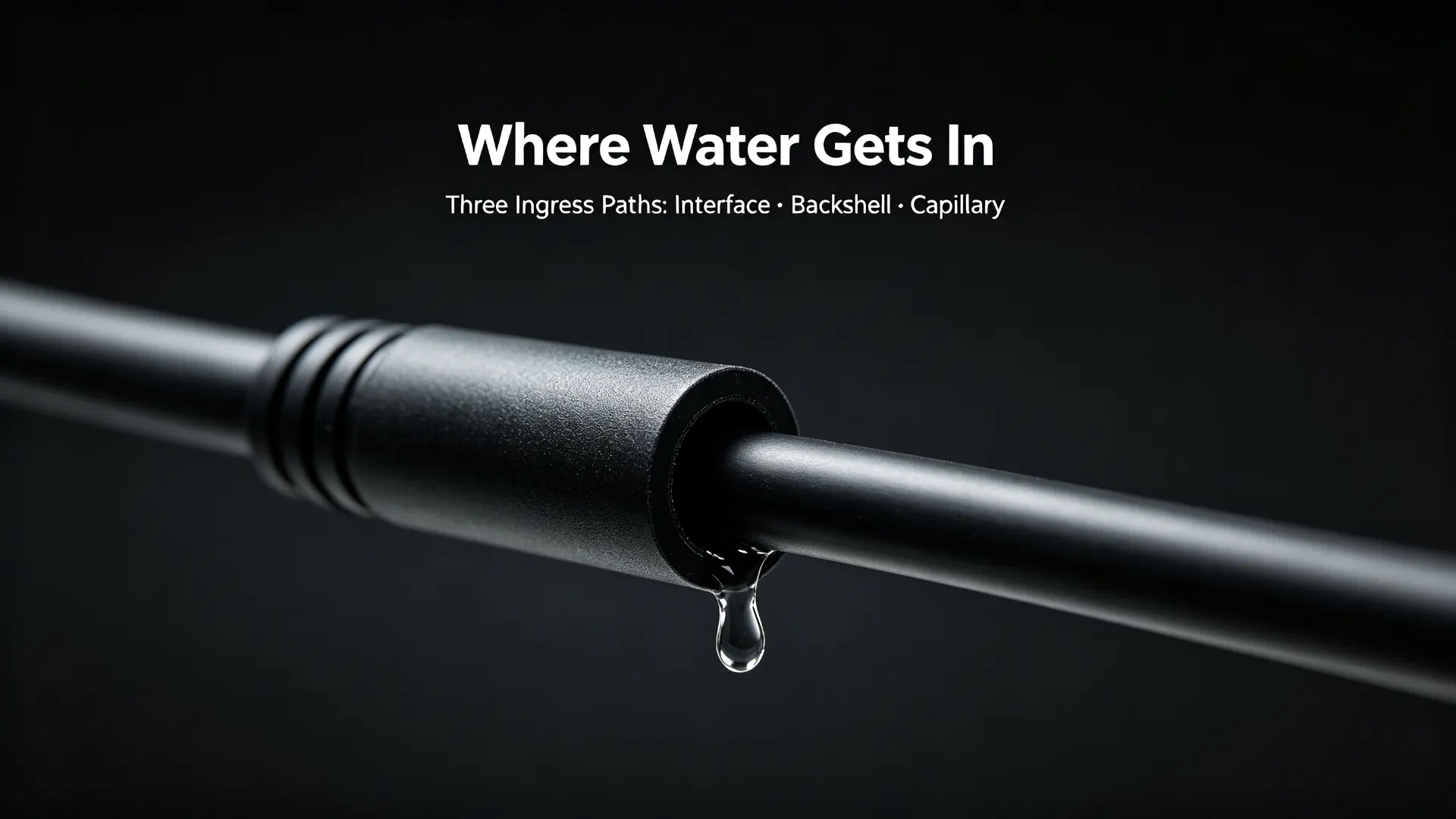
A certified connector alone does not make a waterproof harness. Water enters assemblies through three independent channels, and a reliable build must seal all three:
-
Connector mating interface — the seal between plug and receptacle; the only path a standard IP test directly covers.
-
Cable entry / backshell transition — where the cable exits the connector or enters the enclosure. If the jacket does not bond to the boot or gland, water enters here even when the connector seal is perfect.
-
Capillary migration through conductor strands — moisture wicks along microscopic gaps between stranded cores, passes behind the connector seal, and travels inward into the equipment. This is a potential hidden failure mode that is frequently overlooked during specification.
The practical consequence: the IP rating must be extended to the cable entry and the conductor bundle, not just the connector, and the finished assembly must be verified by test.
Sealing Methods and Material Selection
Manufacturers combine construction techniques to close all three ingress paths. No single method guarantees a rating on its own — the final IP grade depends on the complete structure, seal geometry, material combination, assembly process, and test result. Use the table below as a selection reference, and qualify the full assembly against your own test conditions.
|
Sealing method
|
Typical application
|
Main limitations
|
Items to verify in qualification
|
|---|---|---|---|
|
TPU overmolding
|
High-volume rugged assemblies, automotive, outdoor sensors
|
Needs strong jacket-to-overmold bond; softer grades stressed by rigid jets
|
Bond strength, flex endurance, full-assembly immersion test
|
|
LSR silicone overmolding
|
High-temperature, chemical, and washdown environments
|
Higher material cost
|
Temperature and chemical ratings, jet-washdown test
|
|
PVC overmolding
|
Cost-sensitive indoor IP67 builds
|
Limited low-temperature flexibility; marginal for deep immersion
|
Immersion test at the intended depth
|
|
Single O-ring
|
Standard M12 and circular connectors, shallow IP67
|
Not for deep submersion or jet cleaning
|
Seating force, 1 m / 30 min immersion
|
|
Dual O-ring / captured gasket
|
Mil-spec circular connectors, marine, washdown
|
Requires precision groove geometry
|
Deep submersion at agreed depth/time; jet test for IP69K
|
|
Epoxy back-end potting
|
Blocking capillary wicking; submersible and long-term assemblies
|
Needs cure-process control
|
Dielectric after immersion, capillary-blocking check
|
|
Adhesive heat-shrink
|
Prototypes, field repair, low-pressure indoor wiring
|
Not reliable for deep or continuous submersion
|
Low-pressure splash test only
|
|
Certified cable gland
|
Enclosure and panel cable entry, retrofits
|
Gland must match cable OD and be rated to the environment
|
Gland rating vs requirement, torque and retention
|
Material Matching: Jacket, Overmold, and Seals
Sealing geometry only works when the surrounding materials are compatible. The overmold resin must chemically bond to the cable jacket; an incompatible pair forms micro-gaps that reopen a capillary path regardless of connector quality.
|
Jacket material
|
Core advantages
|
Limitations
|
Primary use case
|
|---|---|---|---|
|
PVC
|
Low cost, flame retardant
|
Poor low-temperature flexibility, limited chemical resistance
|
General indoor IP67 harnesses
|
|
PUR
|
Abrasion, oil, and chemical resistant
|
Higher material cost
|
Robotic, industrial flexing, outdoor wiring
|
|
TPE / TPV
|
Wide temperature range, flexible
|
Sealing needs strict process control
|
Automotive and EV assemblies
|
|
Silicone / LSR
|
Extreme temperature and chemical tolerance
|
High cost, soft surface
|
High-heat washdown, marine
|
Design and Testing Requirements
Design Considerations for Long-Term Reliability
-
Unmated port protection. Specify sealed dust caps for every disconnectable port, and match gasket material and geometry to the expected number of mating cycles.
-
Strain relief. Bending and tension at the cable-to-connector joint is a leading cause of seal fatigue. Use overmolded strain relief and proper routing to isolate the seal from flex and vibration.
-
Environment. Confirm the full operating temperature range, chemical exposure, and UV sunlight before selecting jacket, gasket, and overmold materials.
Verifying a Waterproof Harness
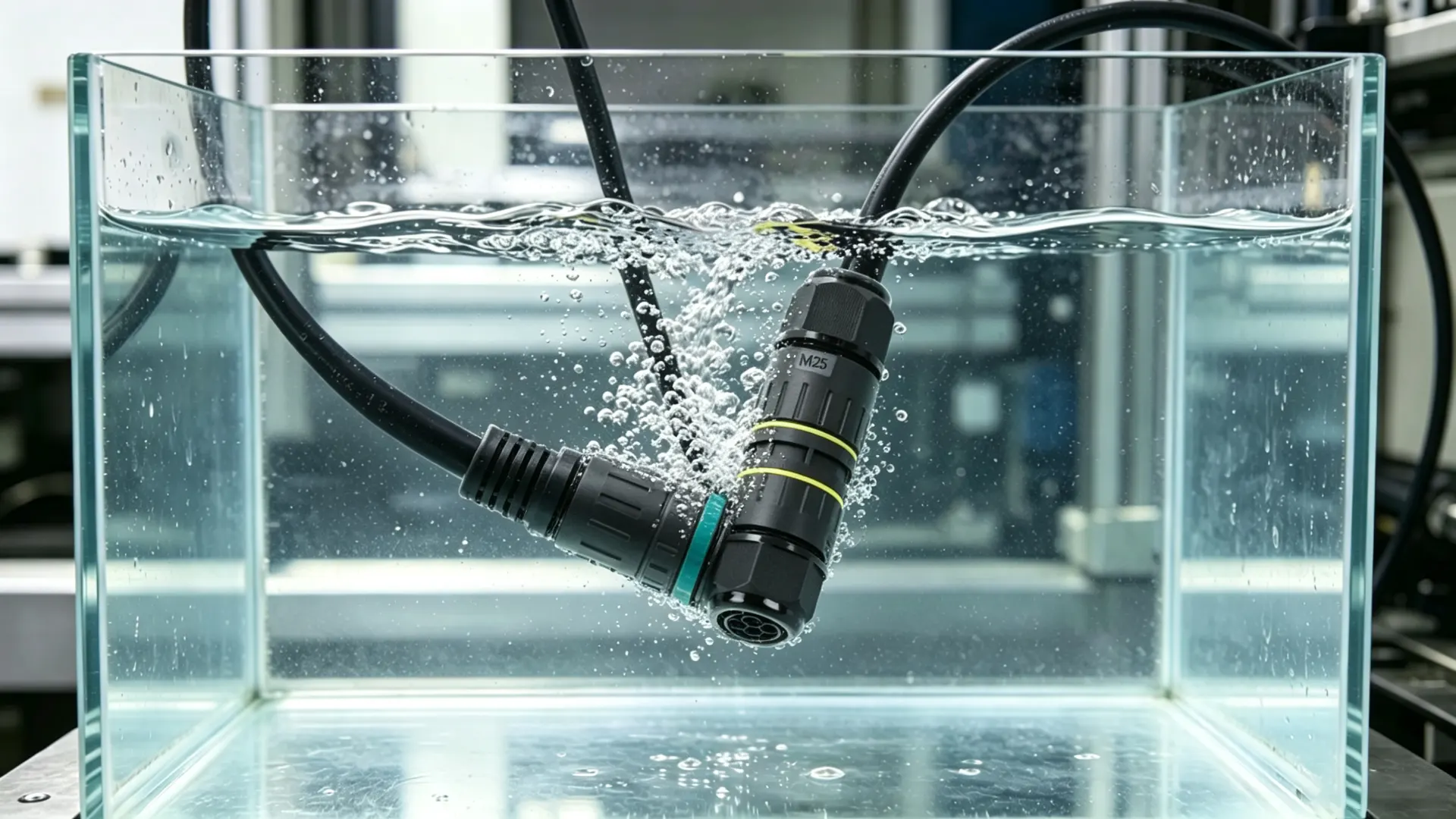
A printed IP label describes a new, freshly mated sample. Test evidence verifies whether the specified assembly meets its intended ingress-protection requirements. A test report and a formal product certification are not the same thing, and the exact test program should follow the design requirements, applicable standard, and customer acceptance criteria.
-
Immersion per IEC 60529: IP67 at 1 m for 30 min; IP68 at the agreed depth and duration; IP69K via 80 °C, 80–100 bar jet cleaning per ISO 20653.
-
Electrical checks after immersion — dielectric strength (hipot) and insulation resistance (IR) — confirm the seal protected the circuit. Dye-penetration inspection is a diagnostic tool for locating a suspected leak path, not a default acceptance test.
-
Production screening such as 100% air-leak testing catches marginal seals, but the test method, pressure, pass/fail criteria, and sampling rate must be defined with the customer rather than assumed as universal.
What to Request From Your Supplier
-
A documented test report stating the exact depth, duration, temperature, and pressure of the rating you specified.
-
Serial-number traceability linking each production batch to its test records.
-
Workmanship acceptance per IPC/WHMA-A-620. The acceptance class is set by the customer drawing, contract, applicable standard, and product risk — Class 3 is for high-reliability, safety-critical applications, while Class 2 is usually sufficient for standard industrial IP67/IP68 assemblies. Do not assume Class 3 from an industry name alone.
Waterproof Wiring Harness Specification Checklist
Use this checklist when writing your specification or RFQ. It lists what to define, not how each test works:
-
Define the operating environment: rain splash, washdown, temporary immersion, or continuous submersion; state exact depth and time if underwater.
-
Lock the IP grade with written test parameters (depth, duration, pressure), not just the code.
-
Document temperature range, chemical exposure, and UV conditions to fix material grades.
-
Select sealing construction (overmolding, O-rings, potting, glands) to close all three ingress paths.
-
Specify sealing caps for unmated ports and the total mating cycles required.
-
Require integrated strain relief to protect cable-transition seals.
-
Define test evidence: immersion reports, hipot and IR data, production leak-test results, and traceability.
-
Agree the IPC/WHMA-A-620 acceptance class based on product risk, not industry name.
Frequently Asked Questions
Does a connector IP rating cover the whole cable assembly?
Only if the assembly is built correctly. Even an IP-certified connector leaks if water wicks along the conductor strands (capillary action). Overmolded cable entry and back-end potting are needed to extend the rating to the full harness.
What does "rated only when mated" mean?
Most connector IP ratings apply only to fully mated plug-receptacle pairs. An unmated port left open in the rain lets water into the cavity, which corrodes contacts once re-mated. Use sealing caps for ports that will be disconnected.
Can an IP67 harness be cleaned with a pressure washer?
Generally not. IP67 is rated for static immersion, not high-velocity jets. Specify IPX6 jet resistance or full IP69K if regular power washdown is part of the operating environment.
What is capillary action and why does it matter?
Capillary action lets water creep along tiny gaps between stranded wire cores, pass the connector seal internally, and enter equipment from inside the wire. It is a potential hidden failure mode; internal potting is the common solution for continuous-submersion IP68 assemblies.
Conclusion
A reliable waterproof wiring harness rests on three pillars: an IP code interpreted by its real test conditions, sealing construction that closes all three ingress paths, and verified test data confirming the full assembly — not just the connector — meets the rating.
Do not rely on labels alone. Define test parameters clearly, match materials to your environment, and enforce complete test documentation and traceability to avoid field leaks.
If you need custom-engineered waterproof wiring harnesses for industrial, automotive EV, or marine applications, our engineering team can define the right IP grade, select compatible materials, and deliver fully tested assemblies with documented results tailored to your project.