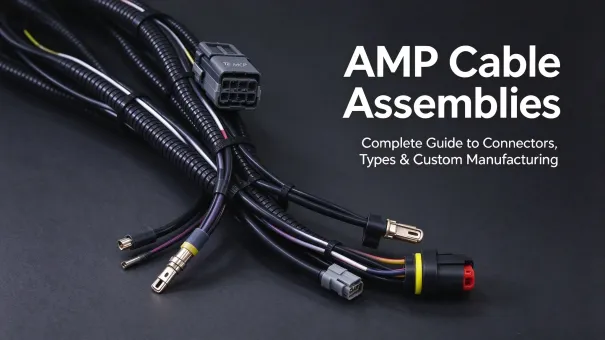
If you are searching for "AMP cable assemblies," you are probably specifying a new harness for a vehicle, machine, or industrial system — or looking for a reliable partner to build one for you. This guide explains what AMP cable assemblies actually are, which AMP connector families exist and when to use each, how to specify a custom assembly correctly, and how to verify quality. By the end, you will be able to write a clearer RFQ and avoid the most common specification mistakes.
What Are AMP Cable Assemblies?
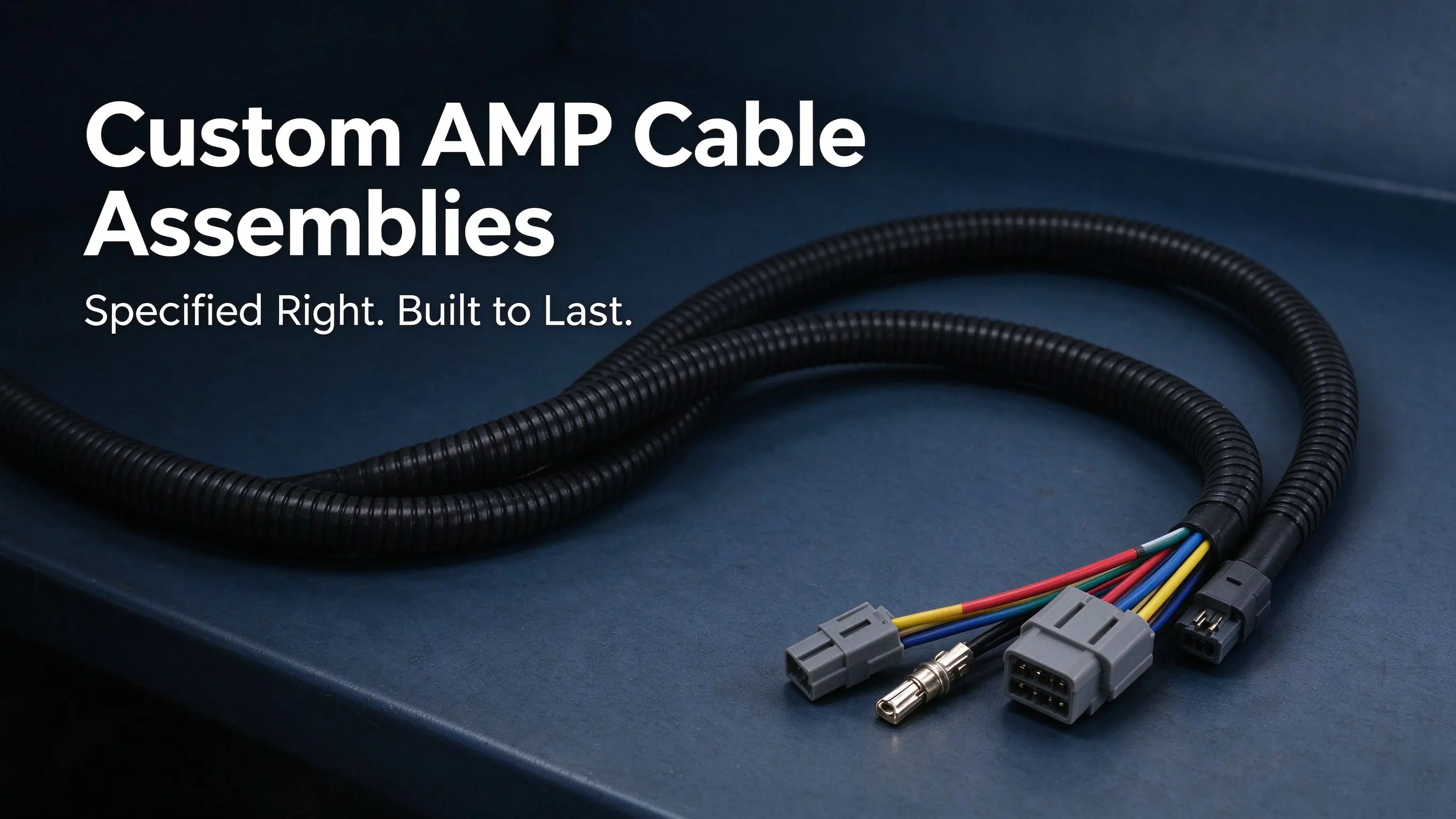
An AMP cable assembly is a cable or wire harness built with compatible connectors from TE Connectivity's AMP product portfolio. Depending on the application, it may include discrete wires, multi-core cable, crimp contacts, seals, backshells, or protective sleeving. The exact configuration depends on the connector family and the electrical and environmental requirements.
Selected AMP connector families are designed for demanding automotive and industrial applications. Actual performance depends on the specific part number, approved operating conditions, compatible terminals and wires, and the quality of the completed assembly.
The AMP Brand Today
AMP originated as AMP Incorporated and is now part of TE Connectivity, following AMP's acquisition by Tyco International in 1999 and the later formation of TE Connectivity. The AMP name remains in use across a wide range of products, including connector housings, terminals, cable assemblies, and crimp tooling. When sourcing an AMP cable assembly, confirm the exact connector and terminal part numbers, component authenticity where required, compatible application tooling, and the manufacturer's process validation and inspection records.
What an AMP Cable Assembly Includes
-
Connector housings (AMP MCP, Superseal, Econoseal, Timer, and others)
-
Contacts / terminals, crimped onto the wire
-
Stranded copper wire, sized to the current path
-
Seals, grommets, or overmolding for water and dust protection
-
Secondary locking and strain relief where required
-
Labels, sleeves, and any routing protection
Why Choose AMP Connectors for Your Harness
AMP connectors are chosen for practical, engineering reasons rather than brand preference alone:
-
Broad portfolio across power levels. The AMP portfolio covers a range of signal and power applications. Each circuit still requires a connector selected for its electrical, mechanical, environmental, and compatibility requirements.
-
Global product availability. AMP products are available through TE Connectivity's worldwide network, simplifying procurement and supply planning.
-
Well-documented termination. Application-specific tooling and published termination specifications support consistent, inspectable crimps.
-
Sealed families for harsh environments. Sealed options help protect connections exposed to water, dust, and chemicals.
Main AMP Connector Families
The table below summarizes AMP connector families you will most often encounter in custom cable assemblies. Ratings such as current, temperature, and sealing differ by part number, terminal, wire size, and application, so treat the table as a starting point and confirm values against the specific product datasheet.
|
Family
|
Typical Use
|
Selection Notes
|
Sealed / Unsealed
|
|---|---|---|---|
|
AMP MCP (MCP 1.5K, 2.8, 6.3/4.8K, 9.5)
|
Engine / ECU / powertrain, signal and power
|
Terminals and cavity sizes differ by MCP variant; performance is not uniform across sizes — confirm by part number
|
Both
|
|
AMP MCON
|
Higher-current powertrain and chassis
|
Power terminals in several sizes; confirm current and sealing by part number
|
Sealed and unsealed, depending on the series and configuration
|
|
AMP Superseal 1.0 / 1.5 and Superseal pro
|
Sensors, lighting, actuators, low-power signal
|
Sealed wire-to-wire and inline connector systems; configurations vary by series
|
Sealed
|
|
AMP Econoseal
|
Industrial and automotive sealed connections
|
Inline sealed connections
|
Sealed
|
|
AMP Timer (JPT / SPT)
|
Signal and medium-power circuits
|
Classic signal / power contacts; configurations vary
|
Sealed or unsealed, depending on the specific product
|
|
AMP Mate-N-Lok
|
Wire-to-wire and panel mount
|
General-purpose housings; mechanical life depends on the specific product
|
Unsealed
|
High-voltage interconnects, including AMP+ high-voltage connector systems and EV charging couplers, form a separate product category from the low- and medium-power connector families above. Standards such as SAE J1772 apply to specific charging interfaces and systems, and compliance must be verified for the specific product, configuration, and applicable standard rather than assumed from the brand.
Where AMP Cable Assemblies Are Used
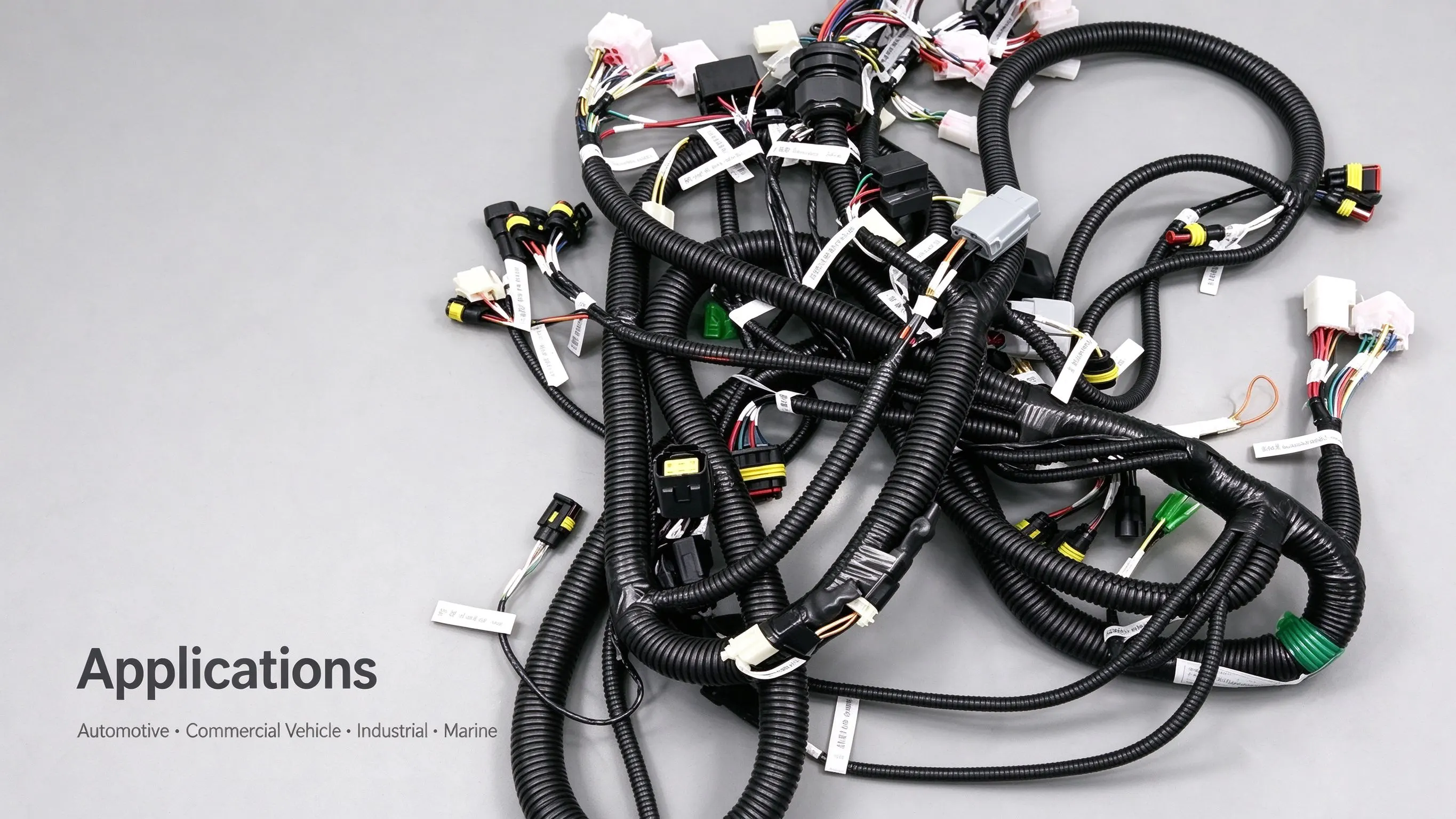
Specific AMP connector families serve different applications; not every family is suitable for every environment or voltage level. In general, AMP cable assemblies appear wherever a connection must survive vibration, temperature swings, moisture, or long service life:
-
Passenger cars: engine and ECU connections, sensors, lighting, body electronics, infotainment
-
Commercial vehicles: trucks and buses, chassis and body wiring
-
Off-highway equipment: construction, agriculture, mining, and forestry machines
-
Industrial equipment: control panels, washdown environments, and outdoor installations
-
Marine and recreational vehicles: salt, spray, and condensation exposure
-
EV and charging infrastructure: high-voltage power paths and charging coupler assemblies, using dedicated high-voltage product families
How to Specify a Custom AMP Cable Assembly
A good specification prevents costly rework and field failures. Work through the following parameters before you request a quote. For a deeper look at manufacturability, review our wire harness DFM guide.
Wire Gauge, Current & Voltage
Choose the wire size from the actual current each circuit carries, not from guesswork. Match the wire gauge selection / mm² cross-section to the ampacity, apply a derating factor for elevated ambient temperature, and keep voltage drop within limits for long runs. Undersized wire overheats and can soften insulation or increase contact resistance; oversized wire adds cost and weight. Confirm the selected wire gauge is within the validated range for the terminal you are using.
Sealing, Temperature & Environment
Decide whether the connection will be exposed to water, dust, washdown, or chemicals. Sealed connector systems can provide protection against water and dust when correctly assembled and used within their specified conditions; the applicable IP rating must be verified for the specific connector configuration and the tested assembly. For guidance on waterproof cable assembly design and IP rating selection, see our dedicated guide. Unsealed connectors suit dry, protected locations. Also define the operating temperature range and any fluid exposure (oil, coolant, brake fluid), because these drive both wire insulation and housing material selection.
Contact Plating
Contact plating should be selected according to the connector manufacturer's specifications, signal requirements, environmental exposure, mating cycles, and contact-system compatibility. Gold plating may be appropriate for certain low-level signal applications, while tin-plated contacts are commonly used in many power and general-purpose circuits. State the plating in your specification so the supplier selects the correct contact for the application.
Wire-to-Connector Compatibility
Not every wire fits every terminal. Specify the wire construction (stranding, insulation type and thickness) and confirm it is compatible with the AMP terminal and its crimp tooling. For help matching connectors and terminals to your application, see our wire harness connector selection guide. Correct terminal–wire matching is a prerequisite for a crimp that passes pull-force testing.
Quality & Testing for AMP Cable Assemblies
Crimp quality is a critical factor in cable assembly reliability, but it is only one part of the overall quality system. Connector assembly, terminal retention, wire routing, sealing, and final electrical testing must also meet the applicable requirements. For automotive wiring, crimp quality should be verified against the applicable terminal manufacturer's specification and the relevant industry or customer requirements. USCAR-21 is one reference for evaluating crimped electrical connections in automotive applications; acceptance criteria depend on the applicable specification, conductor size and construction, terminal design, and test method.
A robust quality plan may include crimp-height monitoring, cross-section analysis, pull-force testing, electrical testing, and documented process controls. Acceptance limits should be established using the applicable specification rather than a generic force value.
Depending on the assembly design and customer requirements, the inspection and validation plan may include:
-
Continuity and short-circuit testing on finished assemblies
-
Insulation resistance or dielectric withstand (hipot) testing where applicable
-
Crimp-height monitoring and cross-section analysis
-
Seal integrity testing for sealed connectors
-
Vibration, temperature cycling, and thermal shock on representative samples
-
Documented inspection records and traceability
Not every item is a 100% production check. In practice, continuity and short-circuit testing are commonly run as production tests on finished assemblies where required, crimp and cross-section inspection typically operate as in-process or sampling controls, and vibration, temperature cycling, and thermal shock are usually design-validation tests on representative samples.
Custom vs. Off-the-Shelf AMP Assemblies
Standard AMP assemblies and pre-made pigtails are fast to source and inexpensive at low volume. A custom assembly is the right call when you need a specific wire length, unique connector combination on each end, a branch or Y-split, specific grommets and overmolds, custom labels, or routing protection — or when your application demands documented quality. See our guide to wire harness cost factors for a fuller comparison.
In practice, most vehicle and equipment programs use custom assemblies because standard lengths and configurations rarely match a real bill of materials. The trade-off is lead time and minimum-order considerations, which is why prototyping and samples are important before volume production.
How to Choose an AMP Cable Assembly Manufacturer
Use this checklist when evaluating a supplier. Each item reduces the chance of a quality surprise later.
-
Genuine parts. Does the supplier use authentic AMP / TE housings and contacts, or look-alikes?
-
Correct tooling. Are terminations made with application-specific dies and validated crimp parameters?
-
Standard compliance. Do they test to the relevant application specs and any customer requirements, and can they show the applicable documents?
-
Test capability. Can they run pull-force, contact resistance, hipot, seal, and continuity testing, and document the results?
-
Documentation. Will you receive inspection reports, test data, and material certificates?
-
Prototyping. Can they provide samples for fit and function before production?
-
Certification. Do they hold ISO 9001 or IATF 16949 certification where applicable, and can they provide current certificates and demonstrate the quality controls your application requires?
FAQ
Are AMP connectors the same as TE Connectivity connectors?
AMP is a TE Connectivity product brand. For a specific connector or terminal, consult the applicable TE product specification and approved tooling documentation to confirm compatibility and requirements.
What is the difference between sealed and unsealed AMP connectors?
Sealed connectors (for example Superseal) include grommets and seals that help stop water and dust from reaching the contacts, making them suitable for harsh or outdoor environments when correctly assembled. Unsealed connectors (such as many Timer and Mate-N-Lok versions) are intended for dry, protected locations and are usually less expensive. The actual IP rating depends on the specific configuration and tested assembly.
How is crimp quality verified on AMP cable assemblies?
Common checks include pull-force testing, crimp-height and cross-section inspection, and contact resistance measurement, with acceptance limits set from the applicable specification (USCAR-21 where it applies) and the terminal manufacturer's data. On finished assemblies, continuity and short-circuit testing confirm the electrical path, and test data should be recorded and traceable.
Can AMP cable assemblies be made to custom lengths?
Yes. Custom assemblies are built to exact wire lengths, connector combinations, and protection features. For custom projects, request prototype samples where appropriate to verify connector compatibility, dimensions, routing, and functional requirements before volume production.
Conclusion
AMP cable assemblies are a dependable, widely available option for automotive, commercial vehicle, and industrial wiring. A successful project depends less on the brand name than on choosing the right connector family for your current, sealing, and environmental requirements, specifying the wire correctly, and working with a manufacturer whose quality plan and test data match your application. To move forward, fill in the specification parameters above and send a clear RFQ to a qualified supplier.