Epoxy potting and conformal coating protect printed circuit boards in different ways. Conformal coating applies a thin protective film to board surfaces, helping reduce moisture and contamination risks while leaving the board inspectable and easier to repair. Potting surrounds components with a cured compound inside a cavity, which can contribute to environmental sealing and mechanical restraint — but at the cost of added weight, thermal mass and a usually non-repairable assembly.
The right choice depends on the operating environment, thermal requirements, repairability strategy, material compatibility and the protection level required for the finished product. This guide compares the two processes, outlines the engineering trade-offs, and points to the standards and verification steps that should gate a production decision.
1. What Is Epoxy Potting?
Potting introduces a liquid compound into a cavity that contains a populated PCB and allows it to cure into a solid mass. Epoxy is the most common chemistry; polyurethane and silicone are used where lower stress or wider temperature range is needed. When the housing stays in the product, the process is called potting; when the mold is removed after cure, it is casting or embedding.
Cured resin bonds to components, leads and housing walls, which can restrict relative movement and help against selected mechanical stresses. However, resin stiffness, coefficient of thermal expansion (CTE), cure shrinkage and component geometry must be evaluated together: a rigid, high-CTE compound in a tightly filled enclosure can also increase stress on solder joints and interfaces during thermal cycling. Potting is an engineering system, not a generic "make it stronger" step.
2. What Is Conformal Coating?
Conformal coating is a thin polymeric film applied so that it follows the contours of the board and its components. It raises surface insulation resistance, slows moisture and ionic contamination diffusion, and reduces the risk of condensation-induced leakage. It is a surface barrier, not a structural encapsulant: it does not fill gaps, lock components mechanically, or by itself establish an enclosure-level ingress rating.
Cured film thickness depends on the chemistry, the application method (selective spray, dip, brush, or vapor deposition) and the product specification. There is no single universal thickness; use the range given on the selected material datasheet and confirmed on the drawing or process control plan.
3. Side-by-Side Comparison
|
Parameter
|
Conformal Coating
|
Epoxy Potting
|
|---|---|---|
|
Thickness
|
Thin surface film; actual value depends on chemistry and process — verify on datasheet
|
Fills the enclosure cavity; thickness set by geometry
|
|
Protection mechanism
|
Raises SIR, slows moisture and contamination diffusion on board surfaces
|
Volumetric fill; restrains movement and can contribute to sealing when the whole system is designed for it
|
|
Moisture / ingress
|
Helps against humidity, condensation and contamination; does not by itself give an enclosure IP rating
|
Can contribute to sealing when resin, enclosure, gaskets and cable entries are designed and validated; the finished product must be tested to the required level (e.g. IEC 60529)
|
|
Mechanical shock and vibration
|
Limited; mainly protects surfaces from abrasion
|
Can damp vibration and restrain movement; benefit depends on modulus, CTE and fill geometry, and may introduce thermal-cycling stress if mismatched
|
|
Chemical exposure
|
Varies by chemistry; check resistance on the datasheet
|
Often good after full cure; compatibility with the specific chemical must still be verified
|
|
Temperature range
|
Varies by formulation and filler. Treat any numeric range in this article as a starting point; always use the selected material's qualified operating limits and the product's actual service profile.
|
|
|
Thermal dissipation
|
Small impact; airflow and convection are largely preserved
|
Adds thermal mass; unfilled resin is a poor conductor. Filled grades can improve the path to a metal housing, but confirm by thermal survey at maximum load
|
|
Weight
|
Small
|
Significant, proportional to cavity volume — include in the weight budget early
|
|
Rework
|
Some chemistries are strippable; others need mechanical removal
|
Rigid epoxy is effectively permanent; soft gels may be removable but repair economics are usually poor
|
|
Inspection and test
|
AOI, X-ray and ICT remain feasible after cure, subject to masking
|
Post-potting electrical test only; visual access to hidden joints is lost
|
|
Typical use
|
Consumer, industrial control, telecom, automotive cabin electronics, humidity-controlled indoor products
|
Under-hood and off-highway modules, marine and outdoor equipment, sealed sensor pods, vibration-exposed sub-assemblies
|
4. Conformal Coating Chemistries at a Glance
IPC-CC-830 is the principal US commercial reference for qualifying conformal coating materials. It covers multiple chemistry families, including acrylic (AR), epoxy (ER), silicone (SR), polyurethane (UR) and parylene / para-xylylene (XY), with additional classifications in later revisions. The standard addresses the material; it is not a finished-product acceptance specification. The table below is a starting point, not a datasheet.
|
Code
|
Chemistry
|
Typical strengths
|
Watch out for
|
|---|---|---|---|
|
AR
|
Acrylic
|
Easiest to apply and strip; good general-purpose SIR protection
|
Limited solvent and chemical resistance
|
|
SR
|
Silicone
|
Flexible; wider temperature range; performs well under thermal cycling and condensing humidity
|
Can be softer and more susceptible to abrasion; outgassing considerations in some applications
|
|
UR
|
Polyurethane
|
Good balance of moisture, abrasion and chemical resistance
|
More difficult to rework and strip
|
|
ER
|
Epoxy (coating)
|
Harder film and good chemical resistance in some formulations
|
Rigidity can concentrate stress on solder joints during thermal cycling; rework is hard
|
|
XY
|
Parylene
|
Very thin, uniform coverage on complex geometries; common in medical, aerospace and high-reliability designs
|
Higher cost; requires vacuum batch processing; specialized removal
|
5. Epoxy Potting Material Considerations
- Cure system and glass transition (Tg). Heat-cure and room-temperature-cure epoxies differ in Tg, exotherm and final mechanical properties. The service temperature should stay below the resin Tg with an appropriate margin; once the resin softens, its dimensional stability and adhesion change.
- Thermal conductivity. Unfilled epoxy is a relatively poor conductor. Alumina- or silica-filled grades can improve heat transfer to a metal housing, but they also increase viscosity and may require vacuum degassing to avoid voids. Whether filled resin helps system-level cooling must be confirmed by thermal survey, not assumed.
- Coefficient of thermal expansion (CTE). Epoxy CTE is typically higher than FR-4 and much higher than silicon die. Mismatch contributes to mechanical stress during thermal cycling. Low-CTE filled formulations and reduced fill around sensitive components can help, but evaluate by test rather than by rule of thumb.
- Cure shrinkage. Shrinkage should be evaluated against assembly geometry, component sensitivity and mechanical constraints. Where solder-joint or component stress is a concern, review the manufacturer's shrinkage data and validate the process through thermal-cycling and reliability testing.
- Alternative chemistries. Polyurethane potting is generally softer and more tolerant of low-temperature service; silicone potting is used where wide temperature range and low stress on fragile parts matter. Epoxy is a starting point that should be justified, not a default.
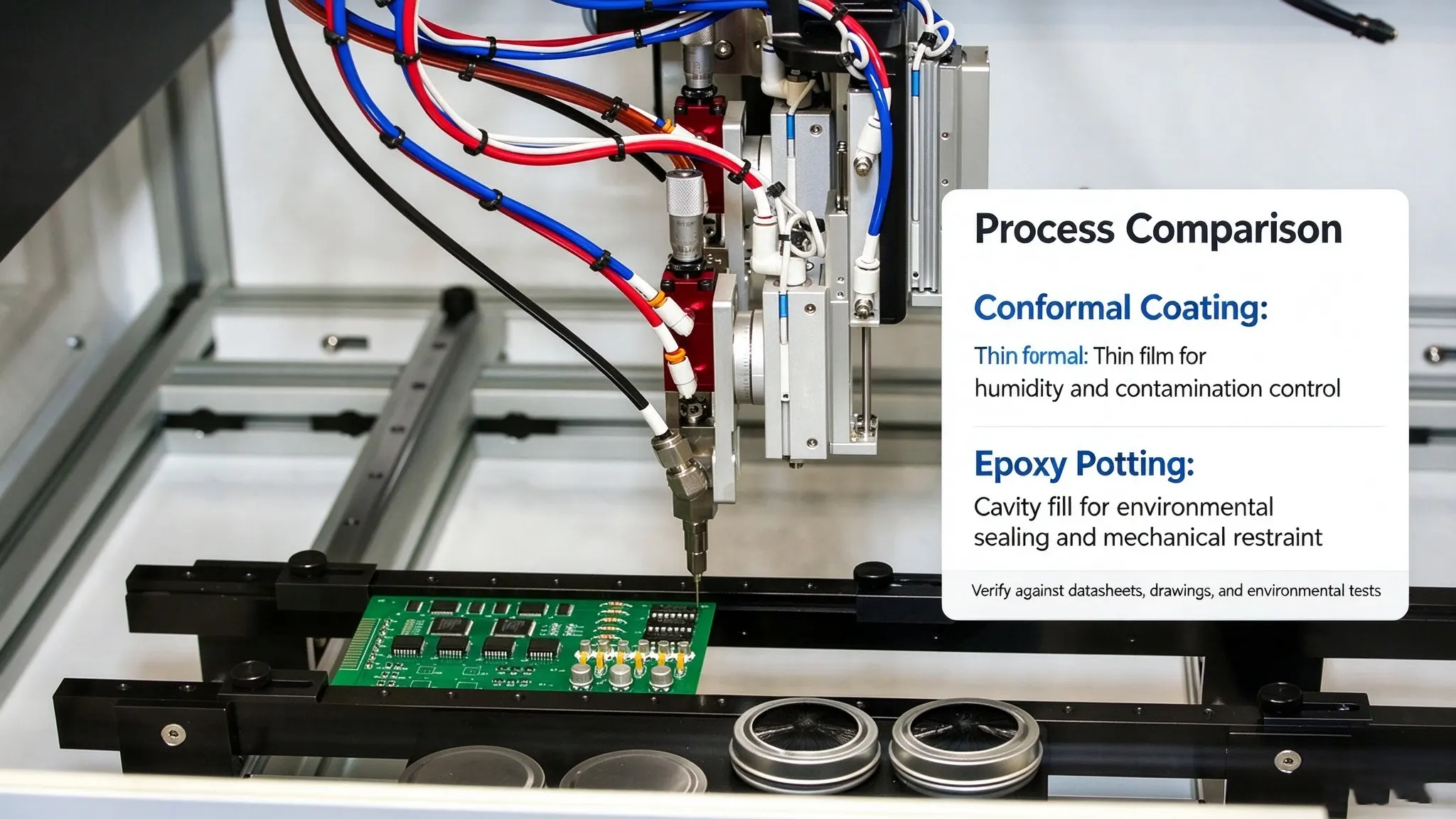
6. How to Choose Between Potting and Conformal Coating
Use the decision tree and the four-step checklist below together. Pick the process against the dominant environmental risk, then confirm against the constraints.
- Identify the dominant environmental risk. Is the primary threat humidity and condensation, immersion, salt mist or chemicals, random vibration and shock, or high voltage? Protection is specified against the dominant risk, not against the sum of every possible risk.
- Decide whether enclosure-level sealing or mechanical immobilization is required. If no, evaluate conformal coating first. If yes, evaluate potting together with the enclosure, gaskets and cable entries — potting is one subsystem of a sealed design, not a substitute for housing engineering.
- Check the constraints. Thermal dissipation, required repairability, weight, material compatibility (with plastics, connector bodies, wire insulation and labels), cure stress and production cost all narrow the choice. A process that wins on protection alone but fails on weight or warranty cost is not a valid choice.
- Validate before production release. Confirm material properties, process parameters (mix ratio, cure schedule, fill volume, void level) and run the environmental, electrical and thermal tests relevant to the product. Do not release on datasheet claims alone.
A few practical rules of thumb: lean toward conformal coating when the product needs field repair, has high power density, or carries connectors, test points and adjustable trimmers that must stay accessible. Lean toward potting when the assembly is designed as a sealed module validated to an ingress level such as IEC 60529 IP67/IP68, when vibration and shock exceed what the bare soldered assembly can hold, or when the product is intended to be replaced as a module rather than repaired on the bench. Potting may be considered as one element of a high-voltage insulation strategy only when the compound, geometry, interfaces and qualification tests satisfy the applicable product safety requirements — it should not be assumed to replace required creepage or clearance distances on its own.
7. Hybrid Approaches
The two processes are not mutually exclusive. A common production pattern is to conformal-coat the full board for baseline humidity and contamination protection, then selectively pot a sub-region — a high-power inductor, a connector bay, or a sensor daughter-board — using dam-and-fill or glob-top. This localizes the mechanical and sealing benefit without paying the full thermal and weight cost of filling the enclosure. Around large, thermally stressed components, a lower-modulus silicone or polyurethane gel can be used so that CTE mismatch does not fatigue solder joints.
8. Standards and Validation
The standards below address different questions and are not interchangeable. Use the version cited in the customer specification or governing product standard.
|
Standard
|
What it covers in this context
|
|---|---|
|
IPC-CC-830
|
Qualification and performance of conformal coating materials for printed board assemblies. Addresses the material, not a finished-product acceptance rule.
|
|
IPC-A-610
|
Acceptability of electronic assemblies, including workmanship for coated assemblies. Apply the revision agreed with the customer.
|
|
IEC 60068
|
Environmental testing methods. Select the specific methods (damp heat, cold, dry heat, random vibration, shock) that match the product's intended environment.
|
|
IEC 60529
|
Classification of degrees of protection provided by enclosures (the IP code). IP ratings describe the finished enclosure, not the coating or potting material on its own.
|
|
MIL-STD-810
|
Environmental engineering considerations and laboratory tests. Apply when the customer contract or product scope references it.
|
|
MIL-I-46058
|
Historical military coating specification; still referenced in some legacy contracts. Follow it only when the governing document names it.
|
|
UL 94 / UL 746 series
|
Flammability and polymeric materials requirements. Whether these, and any CTI requirement, apply depends on the product category, working voltage and certification target — confirm with the applicable UL standard or a certification engineer.
|
Masking requirements are a drawing-level decision. Whether connectors, test points, LEDs, adjustment trimmers or other surfaces must remain free of coating or potting depends on the assembly drawing, material compatibility and process specification. Some connectors may in fact be intended to be potted or sealed; optical surfaces and test points must remain contactable. Define masking on the drawing and process control plan, and validate it against the selected material.
9. Engineering Verification Checklist
The scope depends on the product, environment and applicable standards. The list below is a starting point; pick the relevant rows and define acceptance criteria on the test plan.
|
Item
|
What to check
|
|---|---|
|
Material compatibility
|
Compatibility with plastics, connector bodies, wire insulation, labels and solder mask. Review the manufacturer's compatibility list and spot-check on actual materials.
|
|
Process validation
|
Metering and mix ratio, cure schedule, film or fill thickness, coverage on complex geometries, void level, lot-to-lot repeatability.
|
|
Thermal verification
|
Temperature rise at maximum load, thermal path to housing, condition of solder joints and components after thermal cycling.
|
|
Environmental verification
|
Select damp-heat, salt mist, dust, immersion or chemical-exposure tests based on the actual environment (IEC 60068, IEC 60529 where applicable).
|
|
Electrical verification
|
Insulation resistance, dielectric withstand and any other tests required by the product specification, after coating or potting and after aging.
|
|
Repairability review
|
Confirm the warranty strategy — board swap, module replacement, or in-field rework — and choose the protection process to match.
|
10. Frequently Asked Questions
Can conformal coating achieve IP67?
No. Conformal coating is a surface film and does not by itself provide an enclosure-level ingress rating. IP67 or IP68 (per IEC 60529) is a property of the finished product — housing, gaskets, cable glands and sealing compound together must be tested to the required level.
Is epoxy potting always better than conformal coating?
No. Potting trades repairability, thermal performance and weight for mechanical restraint and contribution to sealing. Over-protecting a low-power, field-serviceable board is a common cost and warranty error. Choose against the dominant environmental risk and the service model, not against the maximum protection level.
Can I rework a potted board?
Rigid epoxy potting is effectively permanent. Soft polyurethane or silicone gels can sometimes be removed, but the labor rarely justifies it. Design the product so that a potted module is replaced as a unit, not repaired on the bench.
Does potting improve heat dissipation?
It depends. Thermally conductive, filled potting can conduct heat from hot components to a metal housing and improve the system-level thermal path. Unfilled epoxy, however, adds thermal mass and may insulate the board. Verify with a thermal survey at maximum load before locking the process.
11. Summary
Conformal coating is a thin surface barrier for humidity and contamination protection where repairability and airflow matter; epoxy potting fills a cavity and can restrain movement and contribute to a sealed enclosure, at the cost of weight, thermal mass and a usually permanent assembly. Select the lightest process that still meets the environmental specification, validate it against the relevant IPC and IEC standards and the product's service model, and treat the datasheet and test plan — not generic rules — as the governing reference.