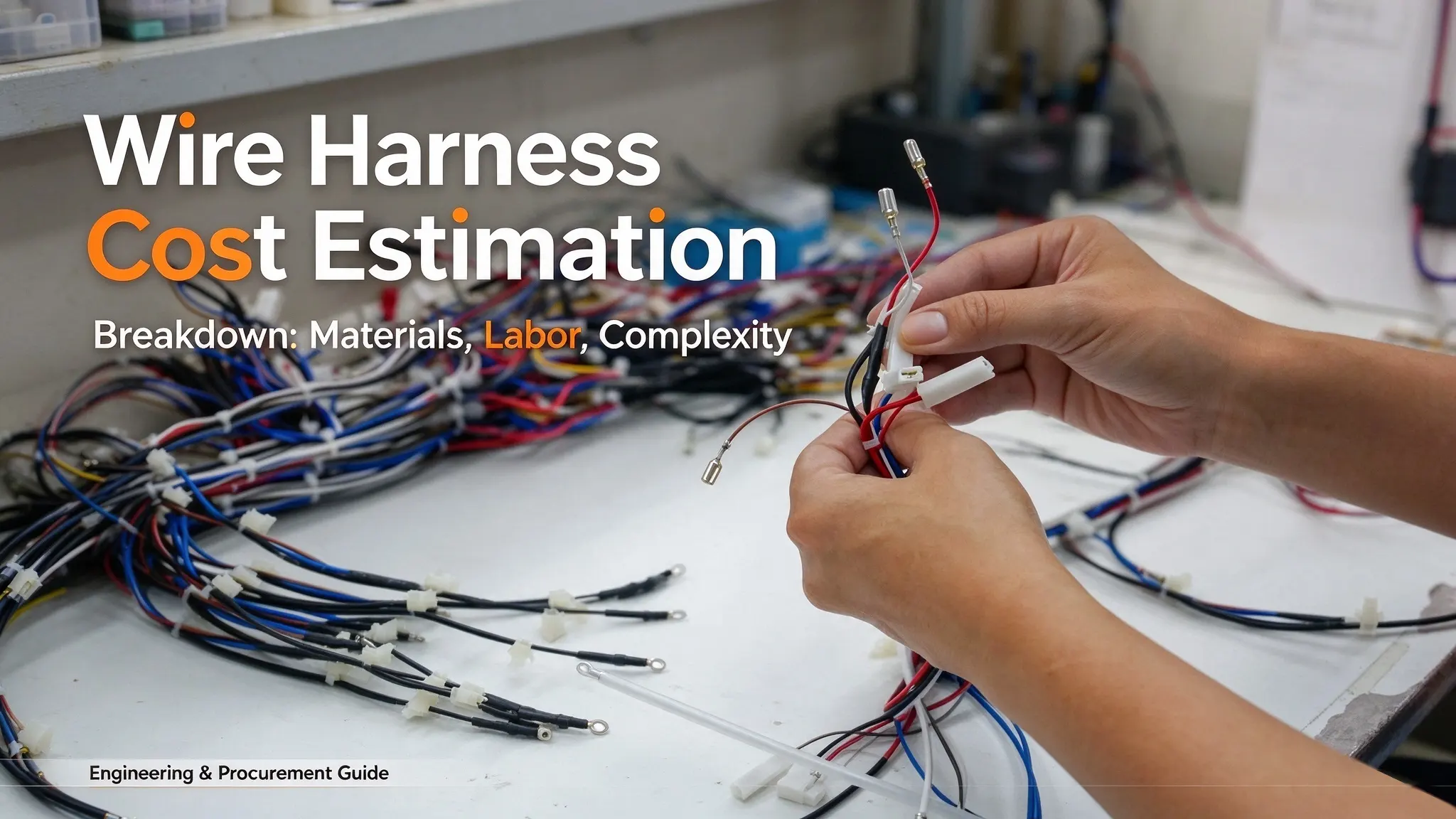
Wire harnesses are foundational components used across automotive, aerospace, industrial automation, and consumer electronics systems. Their final manufacturing and quotation costs are driven by three core, interconnected variables: material specifications, assembly labor requirements, and design complexity. Additional influencing elements include production volume, quality validation standards, and overhead expenses. The relative contribution of each cost factor varies significantly based on harness design, manufacturing processes, and order quantity. A clear understanding of wire harness cost breakdowns enables mechanical and electrical engineers, procurement specialists, and manufacturers to accurately evaluate supplier quotations, avoid unnecessary expenses, and implement targeted cost-reduction strategies while maintaining product performance and reliability.
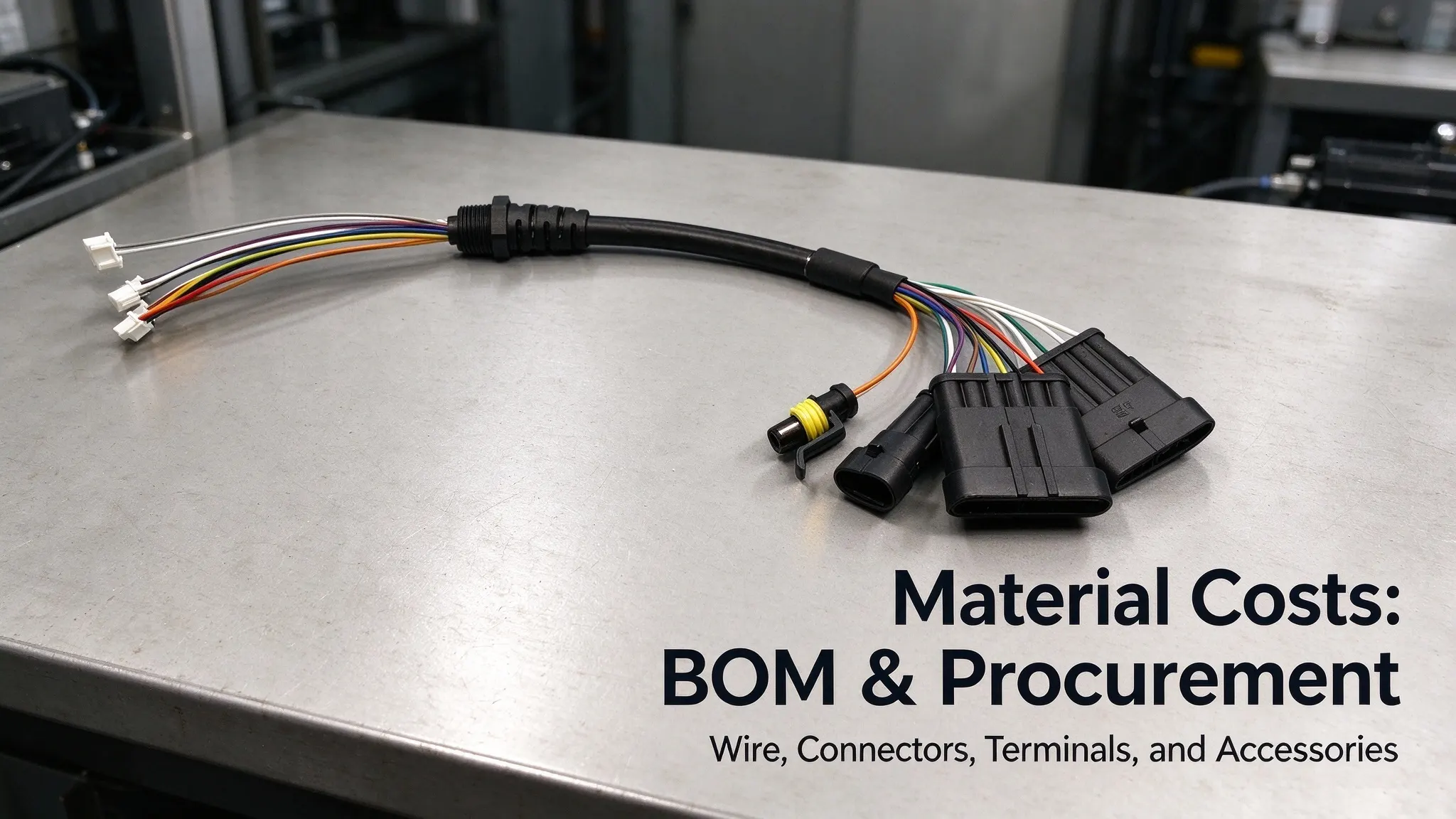
1. Material Costs: BOM and Procurement Factors
Material costs are primarily determined by the project bill of materials (BOM), including wire specifications, connector and terminal part numbers, auxiliary materials, and their respective quantities and purchase prices. Procurement conditions, material waste, and inventory requirements can also affect the final cost. Unlike standardized electronic components, harness material costs are highly customizable, with pricing fluctuations stemming from component grades, purchasing terms, and order volume. Every BOM selection decision directly shapes the baseline cost of a custom wire harness assembly.
Copper is widely used in wire harnesses because of its reliable electrical conductivity and mature manufacturing processes. Other conductor materials, such as aluminum, may be suitable for specific applications depending on weight constraints, electrical performance, mechanical properties, and connection requirements. Wire costs vary with conductor material, cross-sectional gauge, insulation compound, temperature rating, shielding construction, industry approvals, and supplier pricing. Specialized high-performance constructions may cost more than standard PVC-insulated wire, depending on the exact specification and application demands.
Terminals and connector housings represent another critical high-cost material category. Connector costs depend on factors such as current and voltage ratings, contact and housing materials, sealing design, environmental resistance requirements, industry approvals, and official manufacturer part numbers. Sealed or application-specific connectors may cost more than general-purpose alternatives, depending on their specifications and procurement conditions. Custom terminals, waterproof housings, and specialized shielding accessories further raise material expenditures. Auxiliary components, including cable ties, wrapping tape, heat-shrink tubes, labeling materials, and protective sleeves, also accumulate incremental material costs, especially for high-shielding, high-protection harness assemblies.
Beyond component unit prices, practical procurement rules directly affect final material costs. Mass production orders support bulk procurement, secure preferential unit pricing, and optimize material utilization to reduce overall expenses. Small production runs, by contrast, may incur higher unit costs due to supplier minimum order quantities, less favorable purchasing prices, additional material handling workflows, and limited opportunities to reuse project-specific inventory. The actual cost impact depends on supplier terms and the reusability of residual materials for future orders. Unifying approved alternative materials and standardizing BOM specifications are effective ways to optimize material-level costs without compromising product quality or compliance.
2. Labor Costs: Major Variable Cost Component
Wire harness manufacturing features mixed automated and manual workflows. The level of automation varies significantly by process and product design. Wire cutting, stripping, and standard crimping operations can be highly automated for standardized, high-volume orders, while complex routing, branch arrangement, precision connector assembly, customized bundling, and final inspection require substantial manual work—particularly for custom, complex, or low-volume harnesses. Labor costs serve as a major variable cost component, determined by standard working hours, regional labor rates, process difficulty, order volume, and production efficiency rather than superficial indicators such as total wire length.
Termination count is an important labor cost driver, though it is not the sole determinant. Two harnesses with identical termination quantities can differ greatly in assembly time, due to varying terminal types, tooling compatibility, wire routing difficulty, and operational accessibility. Basic termination workflows include precision wire cutting, insulation stripping, crimping, and terminal insertion, with each step requiring standardized manual operation and basic visual inspection.
Complex assembly scenarios further increase labor input. Multi-branch cross routing, fixed-position bundling, customized labeling, and sealed assembly all extend working hours. Electrical continuity testing is commonly specified for wire harness assemblies, while advanced validation such as dielectric withstand testing and insulation resistance testing is only performed when required by applicable design standards or project specifications.
Test methods, acceptance criteria, and inspection frequencies should follow applicable product specifications and the approved quality control plan. Sampling requirements depend on the test method, product risk, and applicable customer or industry requirements, rather than generalized production rules. For low-volume orders, production setup, line changeover, first-article inspection, and material preparation work can raise unit labor costs to varying degrees. Larger production runs spread these fixed preparatory activities across more units, effectively mitigating their impact on per-unit expenses and improving overall production efficiency.
3. Design Complexity: Important Driver of Incremental & Hidden Costs
Design complexity is an important driver of incremental cost in custom wire harness projects. It does not generate direct expenses independently but raises overall manufacturing costs by increasing material diversity, assembly difficulty, tooling requirements, and engineering validation workloads. Its specific impact depends on how design variables alter material selection, assembly operations, production setup, and inspection workflows.
Structural complexity is the most intuitive cost-increasing factor. Simple single-branch, fixed-spec harnesses support standardized, efficient production with mature workflows and low defect rates. Conversely, custom harnesses with multi-circuit crossover layouts, multiple divergent branches, and differentiated wire specifications can increase assembly difficulty, material preparation time, and the risk of wiring errors. Diversified material specifications also raise BOM management complexity and preliminary material preparation costs.
Standardized harness designs may use existing tooling and established production processes, reducing the need for additional engineering or tooling investment. However, setup, validation, or project-specific tooling costs may still apply, depending on the design and manufacturing requirements. For highly customized layouts, projects may require dedicated fixtures, application-specific crimping tooling, test adapters, engineering development, or pre-production trial runs. These non-recurring engineering (NRE) costs may be charged separately or allocated across the total production volume to reduce unit-cost pressure for bulk orders.
Requirements for temperature resistance, chemical compatibility, IP-rated ingress protection, electromagnetic shielding, or flame retardancy may increase material, design, assembly, and validation costs. The actual impact depends on the required performance level and the existing design. Strict application-specific standards may demand upgraded materials, optimized structural designs, or additional compliance validation, which incrementally raise overall manufacturing and verification costs. Complex designs also carry higher potential rework and scrap risks, further increasing overall project expenses based on specific production conditions.
4. Wire Harness Cost Breakdown: What Goes into a Quotation?
A formal custom wire harness quotation consists of direct manufacturing costs, project-specific one-time expenses, and configurable budget adjustments. Our online wire harness cost estimation tool supports fast, budget-level cost calculation for core manufacturing items, while additional engineering, testing, and administrative fees are typically quoted separately based on project requirements. The breakdown below clearly distinguishes items supported by the estimator and supplementary costs involved in formal commercial quotations.
|
Cost Component
|
Main Cost Drivers
|
Included in Estimator?
|
|
Wire Material
|
Wire length per harness, unit wire cost, total wires per assembly
|
Yes
|
|
Terminals
|
Total terminals per harness, individual terminal unit price
|
Yes
|
|
Connector Housings
|
Total housings per harness, individual housing unit price
|
Yes
|
|
Direct Labor
|
Labor hours per harness, regional hourly labor rate
|
Yes
|
|
Scrap & Production Waste
|
Customizable scrap waste factor accounting for trimming loss and production defects
|
Yes
|
|
Overhead & Profit Markup
|
Percentage-based markup covering indirect operational expenses and profit allowance
|
Yes
|
|
Engineering & Tooling (NRE)
|
Custom fixtures, dedicated tooling, pre-production debugging, engineering setup
|
Not separately itemized
|
|
Testing & Quality Validation
|
Electrical testing, inspection, compliance documentation, third-party certification
|
Not separately itemized
|
|
Other Project Costs
|
Packaging, freight, special industry certifications, custom delivery requirements
|
Not separately itemized
|
The estimator calculates preliminary cost estimates using the supplied material, labor, scrap, and markup inputs. The accuracy of the results depends on the quality of the input data and internal calculation assumptions. The configured overhead markup serves only as a flexible budgeting parameter, rather than a detailed itemized accounting of actual factory overhead or net profit. Complex custom harnesses often require additional cost allowances for elevated material waste, repeated setup, and minor rework, which vary based on specific production processes and design difficulty.
Preliminary Budget Calculation Framework (Estimator-Aligned)
The framework below outlines the core budgeting logic adopted by our Harness Cost Estimator for preliminary cost analysis. It illustrates how basic parameters combine to generate budget projections for standard wire harness projects. This structure covers core manufacturing costs only and excludes one-time engineering, testing, and logistic fees required for formal commercial quotations.
|
Cost Item
|
Estimator Calculation Logic
|
|---|---|
|
Total Wire Material Cost
|
Number of Harnesses × Wires per Harness × Wire Length per Harness × Wire Cost per Meter
|
|
Total Terminal Cost
|
Number of Harnesses × Terminals per Harness × Cost per Terminal
|
|
Total Connector Housing Cost
|
Number of Harnesses × Housings per Harness × Cost per Housing
|
|
Total Labor Cost
|
Number of Harnesses × Labor Hrs per Harness × Labor Rate (USD/h)
|
|
Scrap Waste Cost
|
(Total Material Cost + Total Labor Cost) × Scrap Waste Factor (%)
|
|
Subtotal Cost
|
Wire Cost + Terminal Cost + Housing Cost + Labor Cost + Scrap Cost
|
|
Overhead & Profit Markup Cost
|
Subtotal × Overhead Markup (%)
|
|
Estimated Total Project Cost
|
Subtotal + Overhead & Profit Markup Cost
|
|
Per-Unit Harness Cost
|
Total Project Cost ÷ Number of Harnesses
|
This standardized calculation framework helps buyers and engineers input precise parameters, understand cost composition, and conduct fair budget comparisons. All results are for budget reference only; formal quotations integrate additional NRE, testing, certification, and logistics expenses.
5. Practical Cost Optimization Strategies
Material, labor, and complexity factors interact dynamically to determine final costs. Targeted cost reduction must be based on actual design and production conditions, with all optimizations ensuring full compliance with customer performance specifications and certification requirements.
In terms of material cost optimization, prioritize unifying wire and connector specifications to reduce redundant BOM numbers and MOQ costs. Select cost-effective approved alternative materials that meet industry and application standards, and adopt bulk batch procurement for recurring orders to lower unit material prices. Avoid over-specifying high-grade materials for conventional working environments.
For labor cost control, standardize assembly and inspection workflows to improve operator efficiency and reduce rework rates. Improve tooling and fixture configuration for medium and large-batch orders to cut down repetitive manual operations. Optimize wire routing and branch layout designs to reduce complex assembly steps and shorten overall production cycle time.
In design complexity optimization, adopt modular and standardized design schemes to minimize excessive custom branches and unique structural designs. Centralize terminal and connector model selection to improve tooling compatibility and reduce NRE tooling amortization. Clarify testing and verification standards based on actual application scenarios, avoiding unnecessary over-testing and redundant validation costs. Consolidating compatible production runs can improve material purchasing efficiency, reduce setup frequency, and spread certain fixed costs across more units for better cost control.
Data-Driven Cost Reduction Principles (Practical for Procurement & Engineering) Effective wire harness cost optimization targets only changeable cost items without compromising product compliance and reliability. For customer-specified terminal and connector part numbers, prioritize optimizing wire length specifications, material scrap control, and assembly workflows instead of mandatory part substitution. For projects with high labor overhead caused by complex routing, simplify branch layout and adjust assembly sequences to cut redundant working hours. For small-batch custom projects with high NRE amortization, evaluate long-term annual demand to judge whether dedicated tooling investment is cost-effective. When managing low-volume orders, compare the total cost of purchasing materials in one batch, reusing eligible residual inventory, and arranging phased deliveries. Carefully account for additional packaging, freight, handling, and inventory risks before finalizing the most economical solution.
6. Quotation Preparation Checklist for Buyers & Engineers
To obtain accurate, consistent, and competitive wire harness quotations, prepare the following key documents and parameters before consulting suppliers, which also supports precise wire harness cost breakdown analysis:
-
Complete harness design drawings and schematic diagrams
-
Detailed BOM list with wire gauge, length, and material specifications
-
Terminal and connector official part numbers and brand requirements
-
Total order quantity and expected batch production schedule
-
Required testing items, quality standards, and certification requirements
-
Operating environment specifications (temperature, humidity, waterproof, shielding requirements)
-
Required delivery schedule, packaging specifications, shipping terms, and available target unit cost or project budget
-
Annual demand forecast and expected recurring order frequency
-
Approved manufacturer part numbers, permitted alternative materials, and customer-specific change-control requirements
Conclusion
Wire harness cost factors center on material specifications, assembly requirements, design complexity, order volume, and quality compliance standards. Accurate wire harness cost estimation relies on a complete and precise BOM, realistic labor hour evaluation, and full awareness of one-time project costs including engineering, tooling, and testing expenses that vary by custom project. To obtain consistent and comparable supplier quotations, buyers and engineers should define technical and quality requirements early, evaluate compliant material alternatives rationally, and assess both unit manufacturing costs and one-time project costs. Our online Harness Cost Estimator provides a preliminary cost estimate based on the material, labor, scrap, and markup values entered. For a formal quotation, submit harness drawings, BOM lists, order quantities, and applicable quality requirements to evaluate project-specific engineering, tooling, testing, and other custom costs.